In 19th century North Carolina, “academies” were private, secondary-level tuition schools that filled the gap before public high schools existed. They served the children of wealthy or middle-class families, teaching classical languages, mathematics, and moral philosophy to prepare boys for college or young women for polite society. They were run by local trustees, religious denominations, or private headmasters, and relied on student tuition and board fees.
Classes were taught in simple wooden buildings, sometimes with boarding quarters for students who traveled from other counties. Teachers were often college graduates (frequently from the University of North Carolina) or traveling ministers seeking extra income. They maintained strict moral and behavioral oversight, emphasizing religious values, public recitation, and orderly conduct.
Coursework for males at these academies focused on Latin, Greek, English grammar, rhetoric, geography, and advanced arithmetic. The curriculum for females typically centered on the ornamental arts like needlework, painting, and music in addition to core academics.
The Shelby Male and Female Academies were the first of these academies in Cleveland County. The act that established the two institutions was ratified by the North Carolina General Assembly on January 27, 1849.

The act read as follows:
Sec. 1. Be it enacted by the General Assembly of the State of North Carolina, and it is hereby enacted by the authority of the same, That Dr. Thomas Williams, Richard Champion, C. C. Durham, John R. Logan, and Henry Shenck, be, and they are hereby appointed commissioners to contract for, and superintend the building of a male and female academy, in or near the town of Shelby, in the county of Cleveland.
Sec. 2. Be it further enacted, That the said commissioners, or a majority of them, shall have power to purchase or receive by donation, a sufficient quantity of land, not exceeding ten acres for each academy, for suitable building sites for the same, the title to which shall be conveyed to the trustees of said academies for the use and benefit of the same, before the said buildings are erected thereon.
Sec. 3. Be it further enacted, That the commissioners aforesaid shall have power to open books and receive subscriptions for building the said academies; and when the sum of two hundred dollars, to be raised by subscription, shall he subscribed and paid by individuals, or secured to be paid, to the satisfaction of said commissioners, or a majority of them, then the county of Cleveland shall appropriate, by an order of said court, the sum of eight hundred dollars of the county moneys, now in the hands of Treasurer of public buildings, or which may hereafter come into his hands; and the said Treasurer of public buildings is hereby directed to pay over the same to the commissioners aforesaid, as fast as the same may be needed for the purposes aforesaid.
Sec. 4. Be if further enacted, That the commissioners aforesaid, so soon as proper title is obtained for the lands on which to erect the said academies, shall proceed to advertise the letting of the contracts for building the same, for the space of sixty days, in such mode as to them may seem best, at the expiration of which time, they, or a majority of them, shall let the same by public auction to the lowest bidder, or by private contract as to them may seem best; taking bond and security from the contractor for the faithful execution of the work to be constructed of such materials and upon such plan as the said commissioners, or a majority of them, may agree upon: Provided, that the contract or sum to be paid for the erection and completion of the said academies shall not exceed one thousand dollars each.
Thus, it is assumed the Shelby Male and Female Academies could have been established and operating as early as 1849, or at least by the 1850s. The location of these two academies is not explicitly documented. There are, however, statements about the early schools made by Cleveland County citizens who were alive during the time the schools were operating. One was William Davis Babington, Sr. who was born in 1864. At age 72 he gave an interview to Renn Drum of The Cleveland Star in which he recalled various places and events from his youth just after the Civil War. He remembered there were two buildings that collapsed in Shelby long before the now infamous 1928 collapse. “The first was a brick school building on the lot where the present high school now stands, and fell in sometime in the early ’70s.”
In 1936 “the present high school” was located at 204 West Marion Street in Shelby. Was this brick building the Shelby Male Academy?
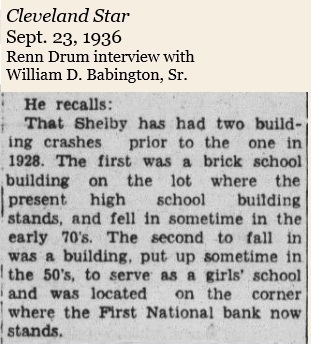
As for the Shelby Female Academy, it is possible it was the “girls’ school” mentioned in this article. Babington states it had been around since the 1850s in the location occupied in 1936 by the First National Bank on Lafayette Street (now BankOZK).
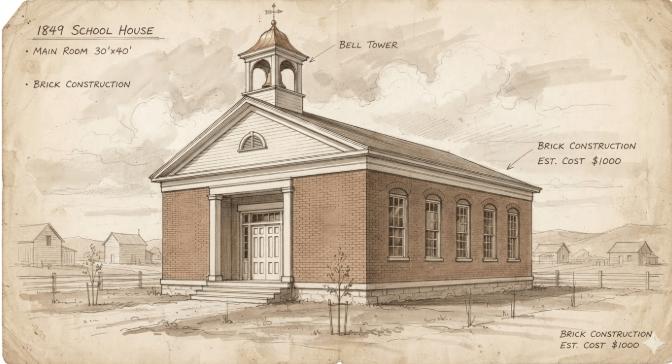
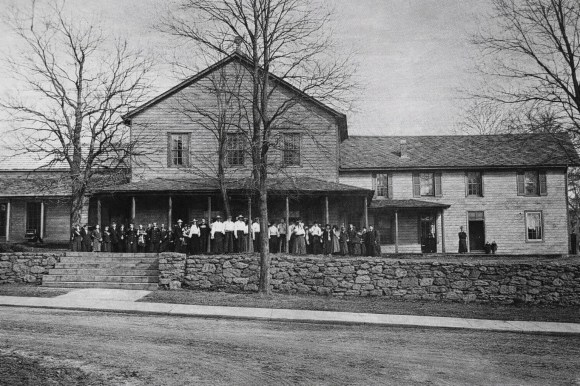
After the brick building on West Marion Street fell in the early 1870s, the building constructed in its place was the one shown below.
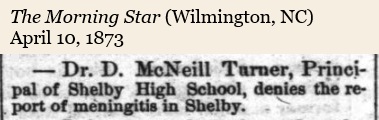
Dr. D. McNeill Turner has been cited as “Shelby High School’s” principal as early as 1870.
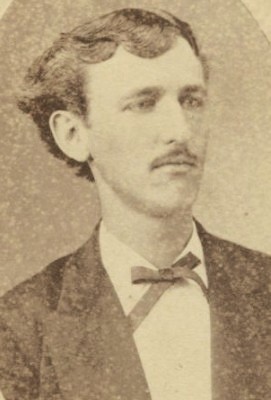
In 1874, the charters of the Shelby Male and Female Academies were revoked by the NC General Assembly. Although the act basically converted the schools to public institutions, they were not granted charters until 1889.
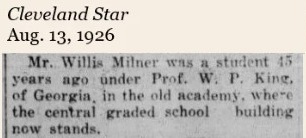
This news item, referring to the old male academy “45 years ago,” would place it in operation under Prof. W. P. King in 1881. Prof. King was Palemon King.

AI-generated image of Palemon King based on his biography at Ancestry.
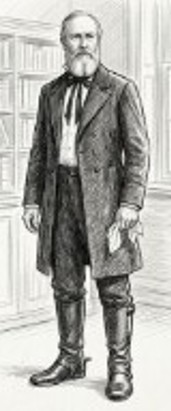
Palemon King has also been cited as an early principal of Shelby High School, so it appears “academy” began to be interchanged with “high school’ during this time period.
The Shelby Military Institute was established in 1887. Captain William T. R. Bell opened the Shelby Military Institute September 12th, 1887, after having established a similar institute in Kings Mountain 11 years prior. Together with Professor Samuel E. Gidney, the school became well respected across the state. Bell operated the Institute for five years before moving to Rutherford County.
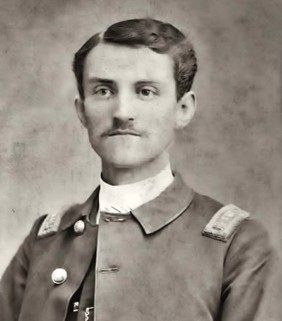
Samuel E. Gidney, a Shelby native, was the first-born son of Capt. John Wells Gidney and Mary McFarland Gidney. As a teacher at the Shelby Military Institute, he had two students who would go on to become governor of North Carolina–Oliver Max Gardner and Clyde R. Hoey. He later served as superintendent of the Shelby Public Schools from 1898-1899.
This article in New Era, provides confirmation that the building that housed the Shelby Military Institute was first used by the Shelby Male Academy.

The Cleaveland Female Seminary was established in 1875. It operated at the Wilson Springs Hotel. T. W. Brevard was the Principal. Little else is known about this school as named. It does appear it was associated with the Shelby Seminary mentioned below.
The Shelby Seminary also began operating in 1875. Its first principal was Rev. Sidney R. Trawick. (Note the advertisement below states, “A department for males. A department for Females.” These two academies appear to have taken the place of the Shelby Male and Female Academies whose charters were revoked in 1874.)

According to Wyan Washburn, the seminary was housed in the original dwelling on East Graham Street known as the Ross Building after its owner and initial builder. It is unclear how long the Shelby Seminary operated, but Washburn found evidence that by the late 1870s Dr. Turner, previously principal at Shelby Male Academy/Shelby High School, opened a school for boys in the same building.
Henry W. Fulenwider, born 1863, recalled events at “Old Doctor Turner’s Boarding School for Boys” in a 1923 interview for the Cleveland Star.

An expansive addition to the Ross Building took place about 1880. Two years later it became home to the Shelby Female College.
Shelby Female College. In the 1800s, public high schools were rare. Often the word “college” would be used loosely to emphasize an institution of higher learning, but primary students might also attend school with the older students there. The Shelby Female College was such an institution.
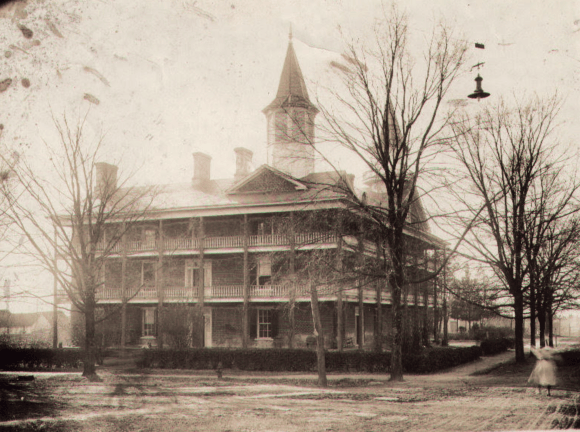
In 1882, the beautiful three-story building at the southeast corner of South Washington and East Graham Streets in Shelby became home to the Shelby Female Academy. The first president of this school was Rev. Richard D. Mallory.
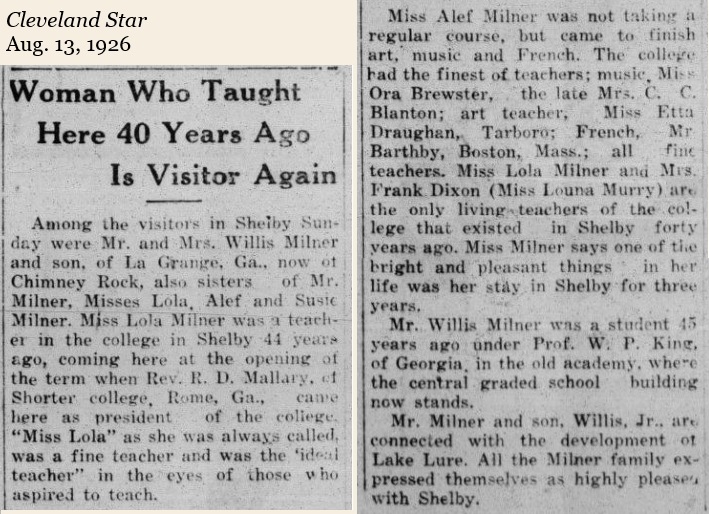
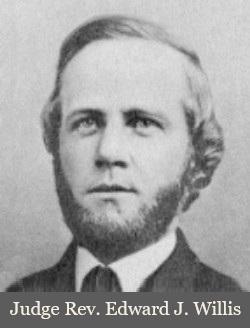
Rev. Mallory resigned in 1887. Assuming his position was Rev. Edward J. Willis who was there until 1889. Due to financial problems, the institution was in decline when Mrs. J. A. McDonald was appointed Principal for the 1889-1890 academic year.
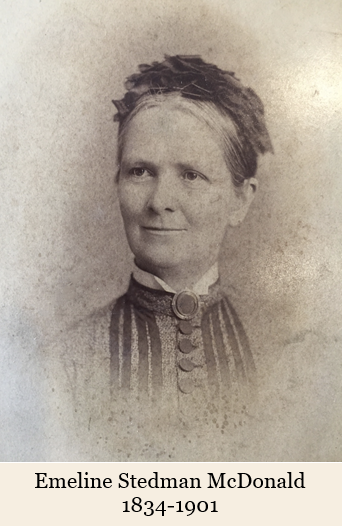
Emeline Stedman McDonald, a Peace Institute graduate, had been hired earlier as a teacher. She was promoted to Principal in the fall of 1889.

After the commencement ceremonies held in June of 1890, Clarence Frick wrote a review that was reprinted in The Daily State Chronicle. An excerpt of his remarks follow:
“The way in which the exercises were carried out reflected great credit upon the scholars, and showed that a great deal of care and hard work had been expended upon them by their teachers. Mrs. J. A. McDonald, formerly of Peace Institute, has had charge of the college during the past year, and, although the college was in a state of decline when she took hold of it, her indomitable will and energy and her well known qualifications have been the means of restoring its former reputation. She has been assisted, during the session, by her daughter, Miss Lina McDonald, a graduate of Peace Institute, and Mrs. W. J. Roberts, who has had charge of the music department. The prospects for the next term of this institution are very bright.”
There are no other newspaper references made to the Shelby Female College the following year. According to Lee Weathers in Our Heritage, Davenport Female College out of Lenoir had consolidated with “a female college in Shelby” for about two years. It is unverified whether this “consolidation” was with the Shelby Female College. At any rate, by 1896 the building was being offered for the establishment of a Presbyterian female college. The Shelby site was not chosen.
According to Cleveland County historian Wyan Washburn, the building that formerly housed the Shelby Female College became home to another McDonald family, then the family of J. Frank Gaffney. In 1899, the building became the College Hotel, then Shelby’s first hospital, before being demolished to make way for the new Shelby City Hall complex in 1939.
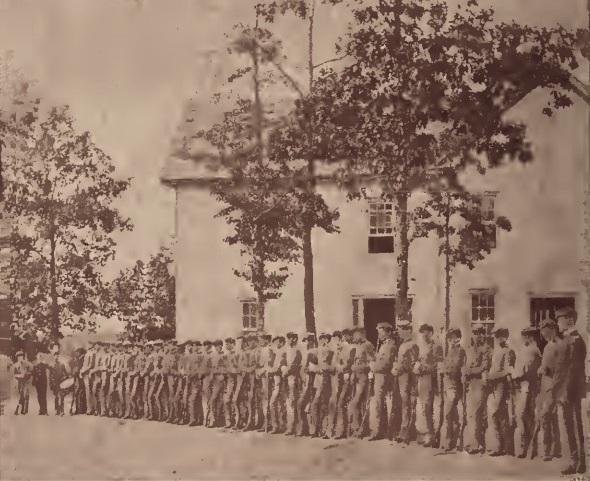
The Kings Mountain Military Institute was started in 1876 by Capt. William T. R. Bell. Bell had taught school at Harlowe Creek in Carteret County, North Carolina just after the Civil War. The school was conducted in the home of Rufus W. Bell (no relation). Nora Bell, the daughter of Rufus, married Bennett Willeford and they moved to Kings Mountain. It was this couple who influenced Capt. Bell to move to Kings Mountain and open a school.
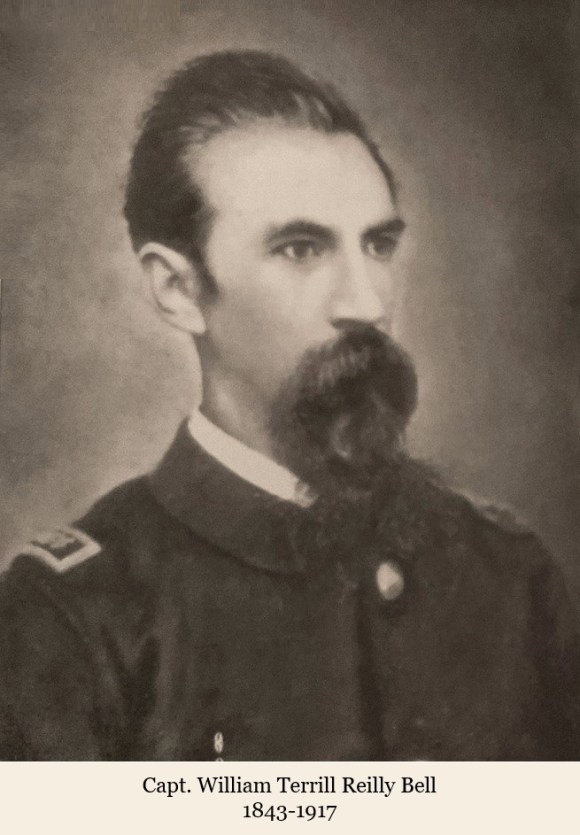
Capt. Bell’s school opened in 1876 with 18 students. That same year, the citizens of Kings Mountain built a two-story frame building. By 1878, they had added a wing to the school and Bell added a military component. That same year the school was converted to the public school of Kings Mountain. Bell was retained as its principal and remained until moving to Shelby in 1887.

The Broad River Academy was established in 1876 under the leadership of headmaster, R. S. Abernathy. This school started with a gift of land made by Mrs. Silas Randall. It was located (and is still standing) on Mt. Sinai Church Road.
In 1982, Pat Poston wrote a brief history of Broad River Academy for the Heritage of Cleveland County book. It is on The Internet Archive.
The Belwood Academy was established in the 1880s by the Methodist Church. It operated under this name and under the leadership of Rev. J. P. Rodgers through 1893. In 1894 the name was changed to the Belwood Institute and Rev. D. P. Tate became the headmaster.
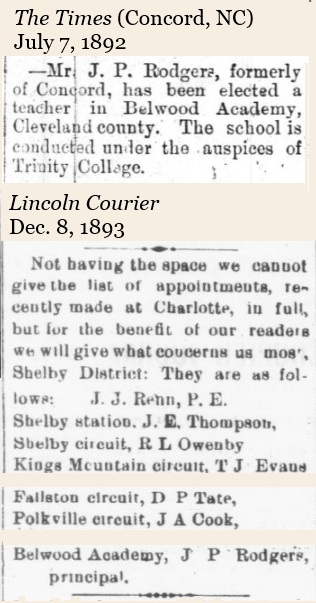
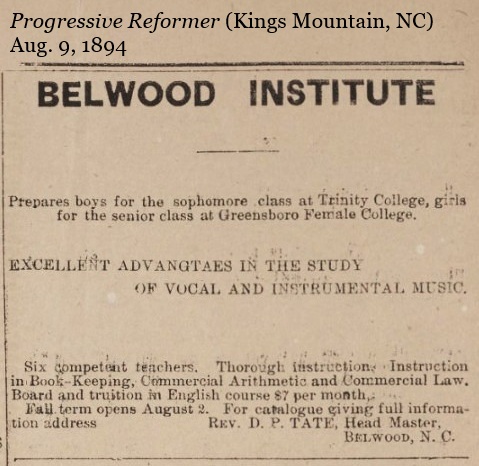
It is unclear when the Belwood Institute became a public school, but newspaper articles indicate sometime before 1919.
Piedmont High School was established in Lawndale in 1896 through the efforts of Major Henry F. Schenck and others at New Bethel Baptist Church. The school’s first principal was W. Banks Dove, followed by William David Burns. The school became a public high school in 1924. Detailed information is at the “Piedmont High School” tab.

White Plains Academy is believed to have been established in 1859 in the area that would become Kings Mountain. According to an article in The Heritage of Cleveland County (1980) the school was associated with El Bethel Church and was located in front of the church. The first teacher was Rev. J. H. Postell.
The Roberts Seminary was established in 1863 by William Roberts of Shelby. Roberts was a wealthy land owner who lived near what is now the Cleveland County Fairgrounds.
The school was operated out of the Roberts family home. Rev. Tillman R. Gaines, pastor at First Baptist Church, was hired as the school’s headmaster. It is unknown how long the school operated.
(Rev. Tillman Rowland Gaines; 1832-1899. Photo from the collection of Kirk Larson.)
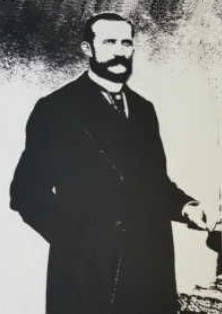
The Sylvanus Erwin Institute was established in Waco by Sylvanus Erwin. The school was in operation during the 1890s before Mr. Erwin’s move to Charlotte about 1899.
Two other 19th century academies were mentioned in Lee B. Weathers’ 1956 book, The Living Past, but little was known about them even then. One was Oates Academy, established in the mid-1870s in Number 4 Township. The other was Davenport Female College which was associated briefly in 1890-1892 with an unidentified female institution in Shelby. Davenport’s main campus was in Lenoir, NC. Shelby Rev. Allan McCorquodale had served on their Board in 1863.

