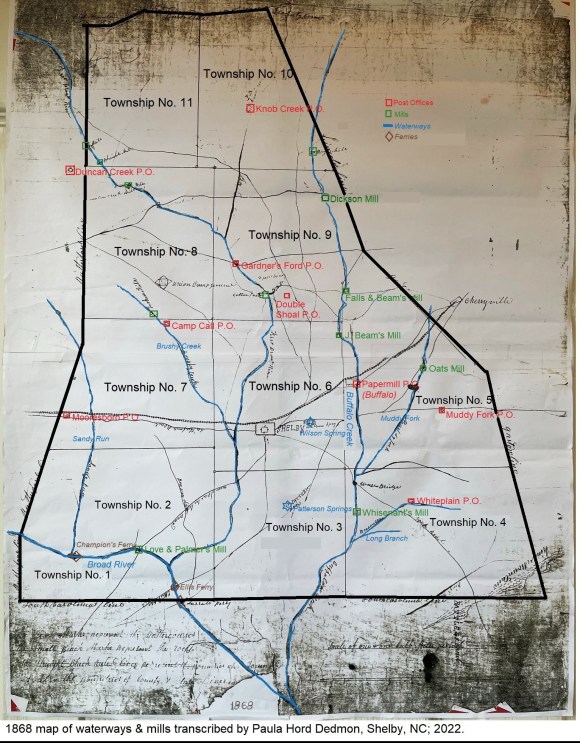
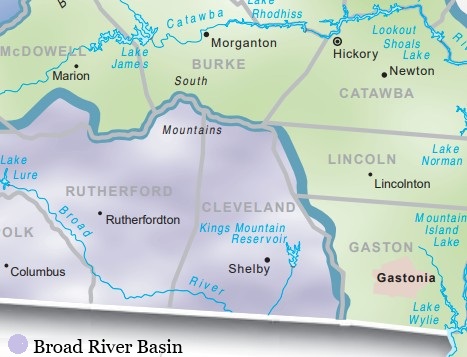
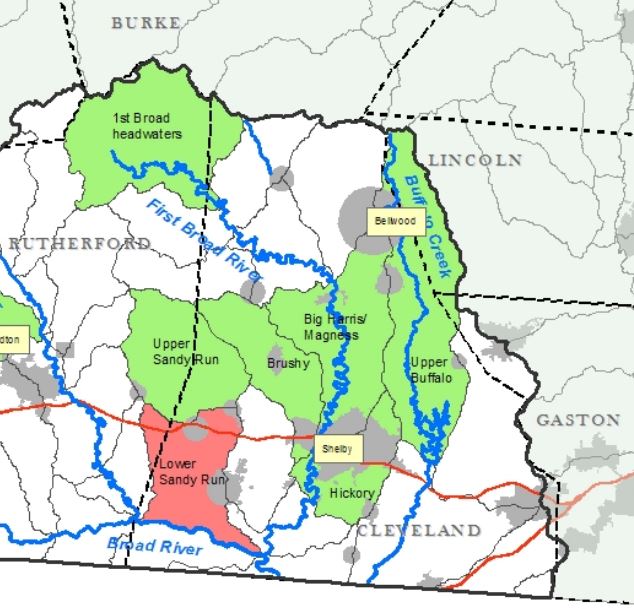
Almost the entire area of Cleveland County lies in the Broad River Basin. For early settlers, the Broad River was the most direct route to the port of Charleston and thereby to England and continental Europe– the best market for the new country’s grain and cotton. Cattle, sheep and hogs were shipped live after being driven overland to the port.
According to the late Dr. Wyan Washburn, the Broad River also had its share of legends and tall tales. “By fact, it was a hideout for deserters and dodgers of both the Revolutionary and Civil Wars, the unwilling citizens hiding in the caves and deep forests along the river.”
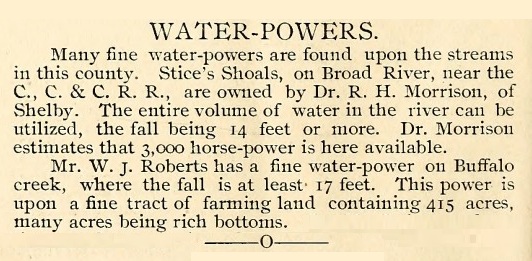
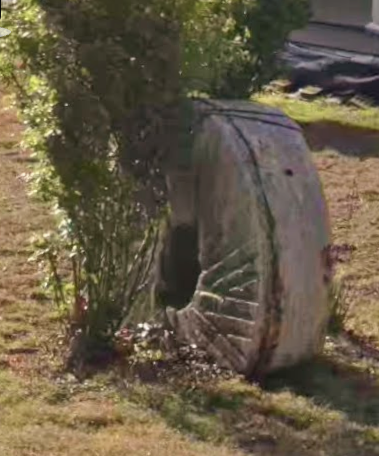
Farmers in the newly-formed Cleveland County used the waters of the Broad River Basin for farming in fertile bottomlands, powering mills, and sustaining a growing population. Later, these rivers and creeks became crucial for industrial manufacturing and public water supply.
The county has several sizable creeks. For an article in celebration of Cleveland County’s first centennial, county historian Madge Webb Riley had this to say about the area’s water sources:
“The county belongs to the great Piedmont belt of the state and the soil, of course, is principally a clay. It is watered, however, by the two broad rivers and several large creeks along which is situated thousands of acres of the richest alluvial bottoms to be found in any old coast state.
One of these creeks, Buffalo, is particularly noted for the large quantity and wonderful fertility of its bottoms. This remarkable stream has its source at the foot of South Mountain in the extreme north and forms the entire length of the county 25 miles. For 20 miles it will average 100 acres of lowlands to the mile. The surface is hilly in the northern part of the county and rolling in the middle and southern sections.
Everything that grows in North Carolina can be grown in Cleveland, except rice, with more or less profit. The soil and climate is admirably adapted to a large variety of crops, as the statistics for the staples will readily show.”
Indeed, Cleveland County enjoys an average annual rainfall of about 48 inches, with the added advantage of being in the Piedmont section where flooding is less of a problem.
Later, these rivers and creeks became crucial for public water supply and industrial manufacturing. In 1860 the county’s population was a little over 12,000 people. By 1960, the population had grown to 66,000. It was at this time that Kings Mountain leaders saw the need for a reservoir to serve the city’s water needs. A dam was built on Buffalo Creek at Oak Grove Road and by 1973, the John Henry Moss Lake reached full pond.
Cleveland County Water was originally created as the Upper Cleveland County Sanitary District in 1980. It later expanded through a merger with the Piedmont Metropolitan District in 1989 and was subsequently renamed Cleveland County Sanitary District, with further infrastructure expansion occurring in 1990 and 1991. The Cleveland County Water Board maintains minutes online and also provides a detailed history on their website.
In the late 1990s, a reservoir project was proposed to address drought concerns and secure long-term water for residential and industrial growth in upper Cleveland County. The project, planned for the Delight area, would cost $95 million and would require the damming of the first Broad River, flooding 1,400 acres of land, including homes, farmland, and streams.
Starting in 1998, rainfall began to decline, leading to what would become a four-year-long drought. The severe drought highlighted the county’s critical dependence on surface waters when the Broad River nearly dried up, threatening local industry.
The drought broke, but county leaders learning a hard lesson put into motion measures to manage and secure the water supply for the future. By 2015, the county had constructed a raw water intake, a raw water holding pond, and sedimentation basins.