September 22, 1836
A meeting is held at the home of Teter Beam (descendant of the German immigrant, John Teeter Beam) to discuss the proposal for a new county.
January 11, 1841
The NC General Assembly passes the act for the formation of a new county. Cleaveland County is created. The name was in honor of Col. Benjamin Cleaveland who was thought to have spelled his name using the “a.” The “a” would be dropped later; the county officially became Cleveland County in 1885.
August 11, 1841
The Cleveland County committee tasked with deciding on the location of a county seat chose the area that would be called Shelby, after accepting the land donated by William Forbes and James Love. (Aug. 11 is the date of the latter’s deed.)
January 25, 1843
Shelby receives its charter of incorporation by the ratification of a legislative act of the General Assembly of NC.
1845
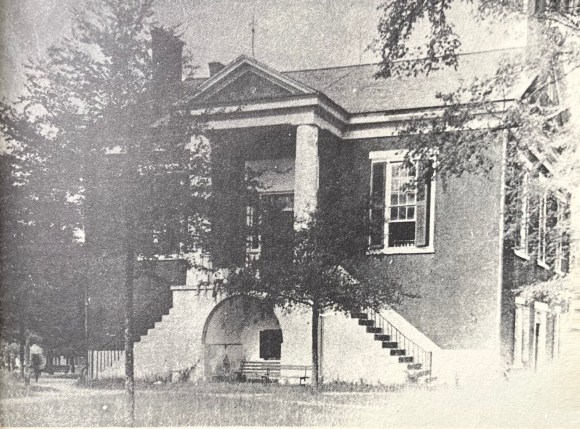
A new brick courthouse is built, replacing the old temporary log structure.
1849
Shelby is reincorporated after having its charter revoked.
June 1, 1850
The enumeration date of the federal census. The county’s first census was taken by Dr. James W. Cabaniss of Polkville between July 29 through October 21. He traveled the county, staying overnight with various residents, so as to complete his task by the enumeration deadline of November 1.
The county’s population was 10,396. More details are in the archives at Gardner-Webb.
June 1, 1860
Cleveland County’s population is 12,348, an 18.8% growth rate from 10 years earlier.
May 20, 1861
North Carolina secedes from the United States. Cleveland County sends 2,035 men to serve in the Confederate Army during the four-year war. This was almost half of the white male population in the county. Some estimate that 24% of the men from Cleveland County died in battle or from disease, 28% were wounded, and 27% were captured.
With so many men off fighting for the Confederacy, Cleveland County women were left struggling to maintain farms and families. When the war ended, those who survived the battles often returned home maimed for life. The Civil War had a devastating effect all over the South that lasted for generations.
January 1, 1863
The Emancipation Proclamation is issued by President Abraham Lincoln. It declared enslaved people in rebelling states to be free. It was a key step towards ending slavery in the United States.
Early 1865
The railroad is extended west from Cherryville to Waco.
April 9, 1865
The Civil War ends. Cleveland County men come home. The Reconstruction Era begins.
February 3, 1870
The 15th Amendment is ratified, granting African American men the right to vote. in 1870. However, many states introduced discriminatory practices and provided enforcement mechanisms.
June 1, 1870
The county’s population is 12,696, a 2.8% increase from 10 years earlier.
1871
The county’s first cotton textile mill is built in Double Shoals, just south of Lawndale.
1872
Railroad service comes to Grover and Kings Mountain.
1873
A second cotton mill is built on Knob Creek just north of Lawndale.
1874
Kings Mountain is incorporated.
Railroad service comes to Shelby.
February 26, 1875
The NC General Assembly ratifies an act to incorporate of the Town of Shelby. This new charter reflects the evolution of the town during the Reconstruction era and the arrival of the railroad.
1880
Waco is incorporated.
Cleveland County has 25 communities with a post office.
June 1, 1880
The county’s population is 16,571, a 30.5% increase from 10 years earlier.
1885
By legislative action, the spelling of the county is changed from “Cleaveland” to “Cleveland” County.
Mooresboro is incorporated.
August 31, 1886
The most powerful earthquake on the east coast occurs at 9:50 PM. The epicenter was just NW of Charleston, SC, but is felt as far north as Boston. Even in Shelby, several structures were damaged.
1887
Grover is incorporated.
1888
The first cotton mill in Kings Mountain opens.
1890
Casar is incorporated.
June 1, 1890
The county’s population is 20,394, a 23.1% increase from 10 years earlier. (The majority of the 1890 census records were destroyed by fire in 1921. Only a small fragment of the census for Cleveland County survived the blaze.)
1891
Earl is incorporated.
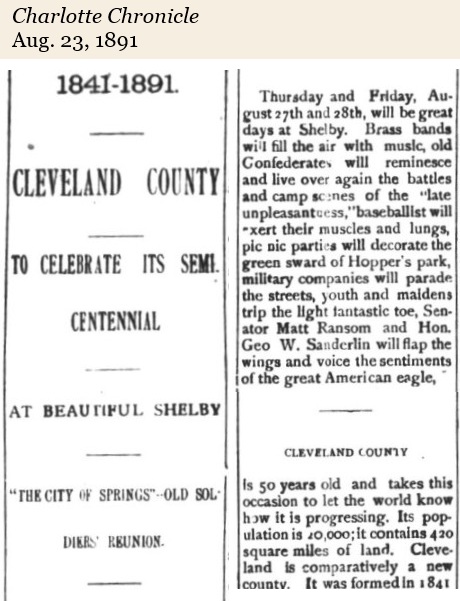
August 27-28, 1891
The county celebrates its Semi-Centennial. News coverage.
1893
Fallston is incorporated.
1895
Lattimore is incorporated.
1898
The Spanish-American War is fought. Over 100 men from Cleveland County enlist for military service.
1899
First National Bank of Shelby is chartered.
1900
First National Bank of Kings Mountain is chartered.
June 1, 1900
The county’s population is 25,078, a 23.0% increase from 10 years earlier.
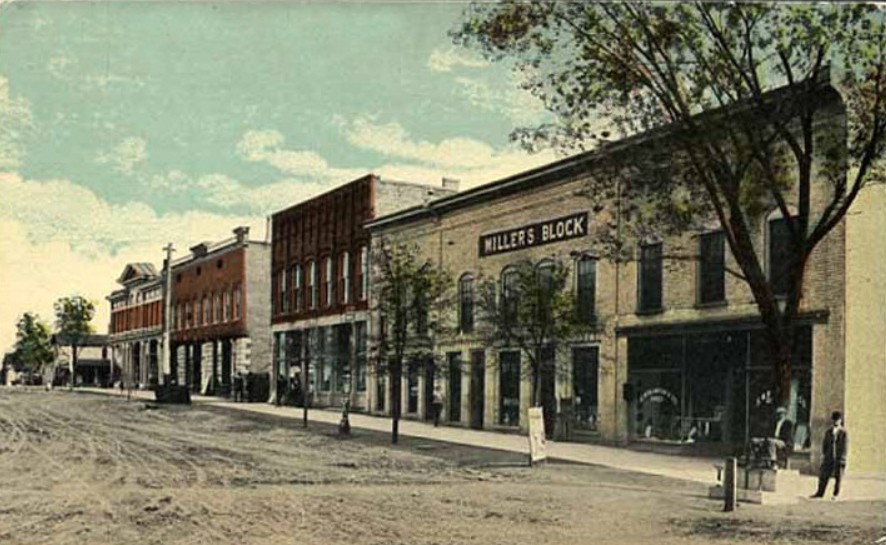
January 26, 1901
A fire on Warren Street in Shelby destroys the Miller Block of businesses. It is rebuilt. News coverage.
1901
A new charter increasing the radius of Shelby to 1 1/2 miles also calls for the “Town of Shelby” to be changed to the “City of Shelby.”
August 4, 1901
Shelby Police Chief Robert Shelton Jones is shot twice while attempting to serve a warrant on a man; he dies at the scene. The shooter is never apprehended. News coverage.
February 14-15, 1902
Snow falls to a depth of 14″+ over Cleveland County.

1903
Lawndale is incorporated.
August 27, 1904
Shelby Police Chief Barnette Edgar Hamrick is shot at the county jail after arresting four men for public drunkenness; he dies early the next day. The shooter, Ben Clark, was convicted and hanged two months later. It was the last public hanging in the county. News coverage.
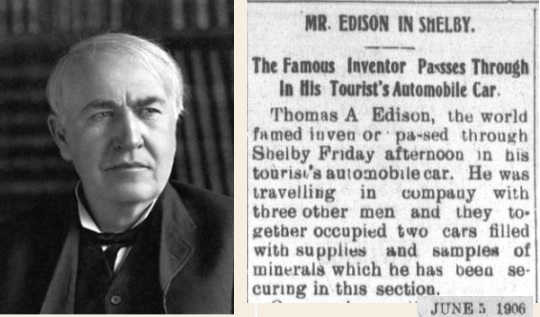
May/June, 1906
Thomas Edison visits Shelby and Kings Mountain.
August 6, 1907
Cleveland County Commissioners declare the courthouse to be “utterly insufficient.” The county hires Falls Construction Company and architect Harry L. Lewman to build a new courthouse in the Classical Revival style. It is finished in 1908.
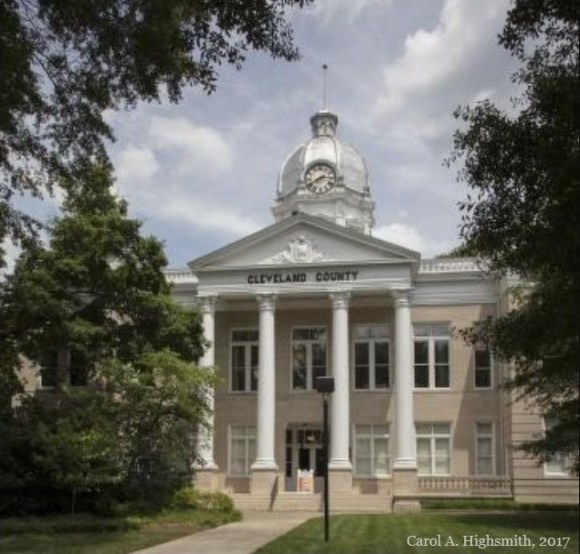
1910
The county gets its first hospital–the Shelby Hospital.
April 15, 1910
The county’s population is 29,494, a 17.6% increase from 10 years earlier.
1911
Boiling Springs is incorporated.
December 12, 1911
Married couple, John and Clayton Cline Dixon, are brutally murdered in their home near Fallston. The crime shocks the community.
October 7, 1913
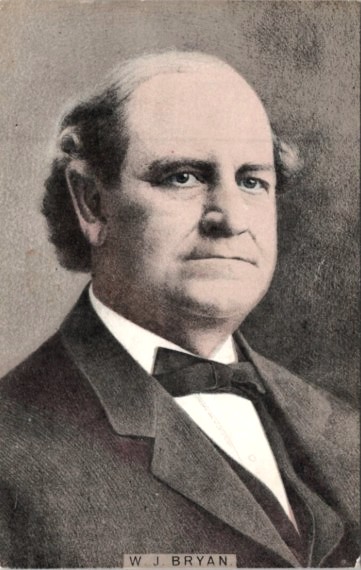
Secretary of State, William Jennings Bryan visits Kings Mountain at the celebration of the 133rd anniversary of the Battle of Kings Mountain.
July, 1916
Within a week-long period, two back-to-back hurricanes drop more than 26 inches of rain over western North Carolina, leaving most of the region inundated and its riverways overflowing. Ten bridges in Cleveland County are either badly damaged or swept away. The event will be remembered as “The Great Flood.”
April 6, 1917
The United States enters World War I. Cleveland County sends 700 for military service.
1918-1920
The Spanish Flu pandemic hits Cleveland County. Within a month of the first reported case of Spanish Flu in North Carolina, 25 citizens of Cleveland County die.

In Cleveland County, one family in particular was devastated by the disease. Plato McSwain lost his wife and five of his twelve children. They are buried in the Elizabeth Baptist Church Cemetery. January 25, 1919
The wooden portion of a train trestle over Sandy Run Creek near Mooresboro collapses as a Seaboard freight train travels over it. The quick-thinking engineer jerked the throttle wide open attempting to race past the wooden portion and onto the steel span. Eighteen cars left the track, but no crew members were killed.
January 1, 1920
The county’s population is 34,272, a 16.2% increase from 10 years earlier.
August 18, 1920
The 19th Amendment is ratified granting women the right to vote.
October 14, 1924
The first Cleveland County Fair is held.
1925
The Cleveland County Negro Fair is organized.
1928
Boiling Springs High School becomes Boiling Springs Junior College.
February 23, 1928
A fire at Shelby’s Central Hotel on West Warren Street kills three people. A fourth victim dies three months later.
August 28, 1928
The McKnight Building, temporarily housing the First National Bank on West Warren Street, collapses. Six people were killed; 12 were injured.
November 6, 1928
Oliver Max Gardner of Shelby is elected Governor of North Carolina.
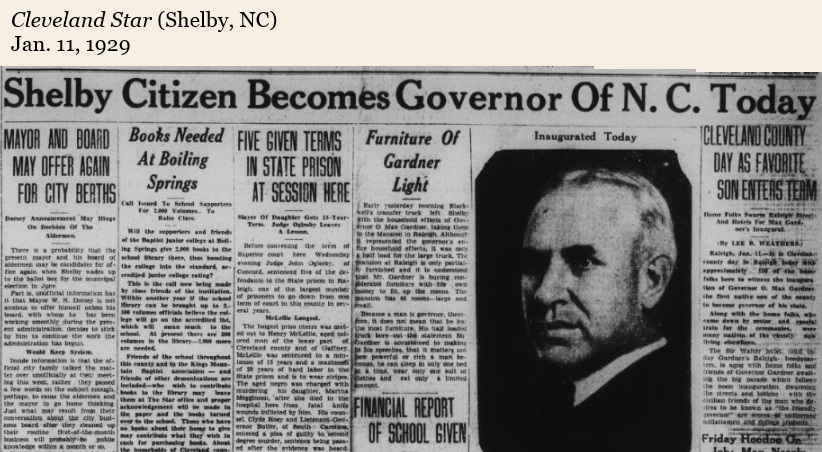
October 29, 1929
The stock market crashes. Referred to as “Black Tuesday,” this and other events caused the Great Depression that would last ten years.
April 1, 1930
The county’s population is 51,914, a 51.5% increase from 10 years earlier.
July 5, 1930
Cleveland County Deputy Sheriff Sanford Pruett is intentionally struck and killed by the driver of an auto which he, four other Cleveland County Sheriff’s Deputies, and a U. S. Federal Revenue Officer had stopped.
October 7, 1930
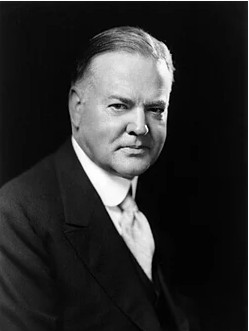
President Herbert Hoover visits the Kings Mountain area for the 150th anniversary of the Battle of Kings Mountain. The battleground site became a national park the following year.
January 1, 1933
Cleveland County Deputy Sheriff Ewart Sanders is shot and killed by a prisoner he and another deputy were transporting to the Cleveland County Jail.
September 10, 1936
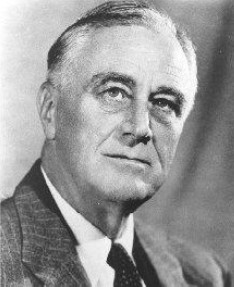
President Franklin D. Roosevelt passes through Shelby and Kings Mountain. Thousands lined up along Warren Street fail to see him due to a mix up over the route. Roosevelt’s motorcade traveled along Marion Street.
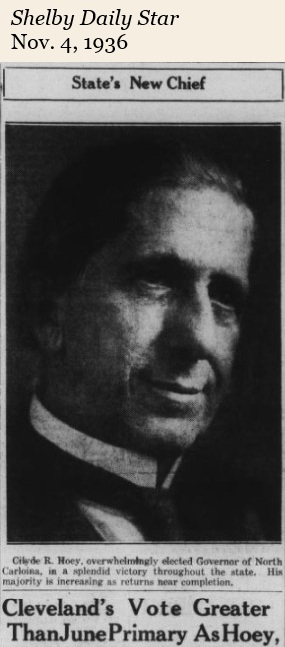
November 3, 1936
Clyde Roark Hoey of Shelby is elected Governor of North Carolina.
April 1, 1940
The county’s population is 58,055, an 11.8% increase from 10 years earlier.
December 8, 1941
Japan bombs Pearl Harbor prompting the United States to enter World War II. Cleveland County sends 6500 into military service over the next four years. At least eight Navy men from Cleveland County are there: Roy Bailes, James Grady Blackwell, Leonard Harvey, Joe Shell (injured), James Smith, John Levi Whitener, and J. D. Wood. Rowena Meredith Hord Brown, granddaughter of Richard T. Hord, one of Cleveland County’s founding members, and her husband Lieut. Harold Sidney “Ted” Brown were there as well.
1943
Mooresboro is reincorporated after having lost its original charter.
March 7, 1950
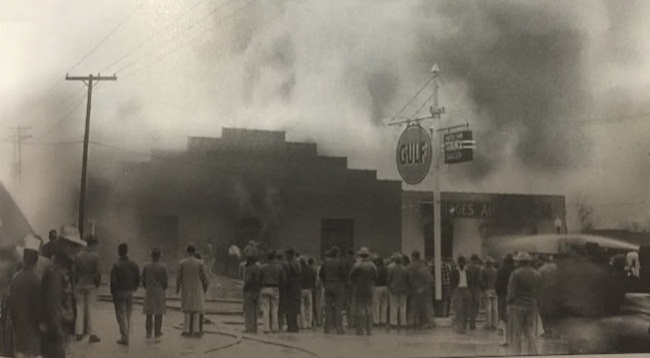
A fire on West Warren Street in Shelby destroys a Gulf Station, Bridges Auto Parts, Ellis Bicycle Shop, and Kendall Drug Store. A new Sears store is built on the site.
April 1, 1950
The county’s population is 64,357, a 10.9% increase from 10 years earlier.
May 17, 1954
The U.S. Supreme Court, in Brown v. Board of Education, rules unanimously that “separate educational facilities are inherently unequal.” The ruling legally ends racial segregation in public schools and overrules the “separate but equal” principle set forth in Plessy v. Ferguson in 1889.
June 13, 1956
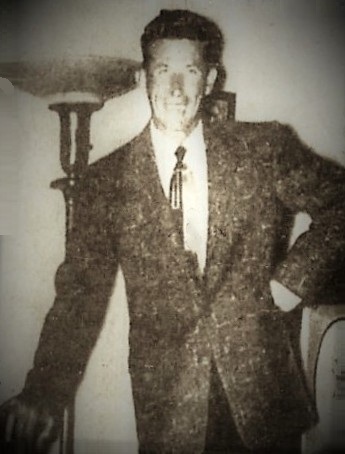
Oran Pruitt falls to his death after opening a Piedmont Airlines exit door by mistake. He fell from an altitude of 6500 feet into the Zion Church Cemetery. Read more. . .
October 21, 1959
Pittsburg Plate Glass (PPG) opens near Lattimore. The company celebrates by inviting the public to tour the new manufacturing plant.
Months later, Fiber Industries opens near Earl. It would become the largest employer in the county.
February 18, 1960
A group of Black high school students stage a sit-in at the Smith’s Drug Store and bus station lunch counters on Warren Street in Shelby. Theirs was one of many occurring across the nation in an effort to advance civil rights.
April 1, 1960
The county’s population is 66,048, a 2.6% increase from 10 years earlier.
March, 1960
The county has snowfall on three consecutive Wednesdays. The total amount of snow for that winter was 27 inches.
1963
Shelby City Schools begin desegregation, becoming fully desegregated by the 1967-1968 academic year. Cleveland County schools begin integrating in 1965.
July 2, 1964
The Civil Rights Act is passed. The act outlawed discrimination based on race, color, religion, sex, and national origin in the United States. It prohibited discrimination in public accommodations, education, employment, and federally assisted programs. The act also strengthened voting rights and empowered the Attorney General to enforce these protections.
1965
The Cleveland County Historical Association is organized.
July 1, 1965
Gaston College opens a satellite campus in Shelby. The campus would become independent two years later and operate as Cleveland County Technical Institute.
July 27, 1966
The body of eleven-year-old Brenda Sue Brown is found by rescue workers in a wooded area in south Shelby. With no leads and insufficient evidence to make an arrest, the murder becomes a cold case.
June 22, 1968
Two years after the Brown case, Mary Helen Kendrick Williams is murdered. At first it was believed the two cases were linked; they were not.
November 2, 1968
Kings Mountain Patrolman Donald Henderson was killed in an automobile crash during a high-speed pursuit on NC 216.
1970
The City of Shelby wins the All-America City award given by the National Civic League.
Clarence Palmer is elected the first black member of the Shelby Board of Education.
April 1, 1970
The county’s population is 72,556, a 9.9% increase from 10 years earlier.
1971
A new Cleveland County Courthouse is built at Justice Place and E. Warren Streets.
Polkville is incorporated.
Fallston is reincorporated.
1973
Patterson Springs is incorporated.
Moss Lake fills to full pond in the fall after years of planning and construction made possible by a federal grant written by Kings Mountain mayor, John Henry Moss.
1974
The county’s fourth courthouse opens. (The photo shows the original facade.)
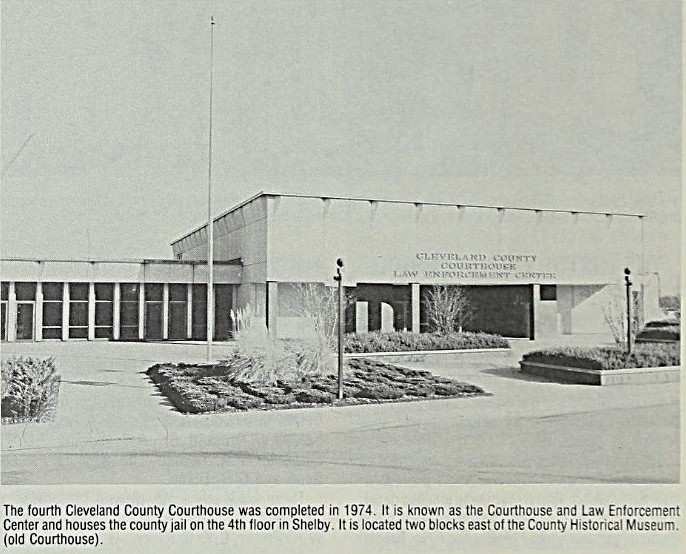
Photo from The Heritage of Cleveland County, Vol. 1, 1982. September 4, 1974
Cleveland County Chief Sheriff’s Deputy George Allen According to his sister, Freida Allen Hawkins: “He died from a very tragic automobile accident. He was taking a prisoner to Raleigh, when a truck came across center lane and hit his car head on, on the bridge. He was killed instantly; he was decapitated. He had a friend with him, who was also killed. The prisoner was not touched and was sitting on the side of the road when the highway patrol arrived.”
October 28, 1974
The Equal Credit Opportunity Act passes Congress, allowing women to open bank accounts and apply for credit without requiring a man as a cosigner.
1976
Sam Raper is elected the first black member of the Shelby City Council.
Through the efforts of Dr. Wyan Washburn, the old court house becomes the Cleveland County Historical Museum.
Malcolm Brown Auditorium is completed in Shelby.
1978
Belwood is incorporated.
May 25, 1979
An explosion on West Warren Street in Shelby kills four firemen and a city utilities employee. 31 are injured. Read more. . .
April 1, 1980
The county’s population is 83,435, a 15.0% increase from 10 years earlier.
1982
Cleveland County gets its first shopping mall at the corner of Hwy. 74 and Marion Street in Shelby.
1984
Hurst Jaws of Life, Inc. relocates to Shelby.
January 17, 1987
Five men inside the Shelby III Adult Bookstore are shot, execution-style, in the back of the head. Three of the men die from the gunshot wounds; two survive and escape the building that had been set on fire.
May 5, 1989
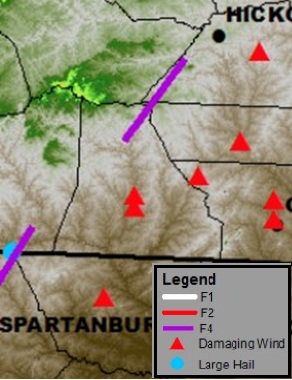
An F4 half-mile wide, multiple-vortex tornado touches down northwest of Lawndale and tracks toward Toluca. Fifteen homes and two churches are destroyed; 34 other homes are damaged. In Lincoln County, the tornado strikes Toluca, killing four people.
In July, Kingstown is incorporated.
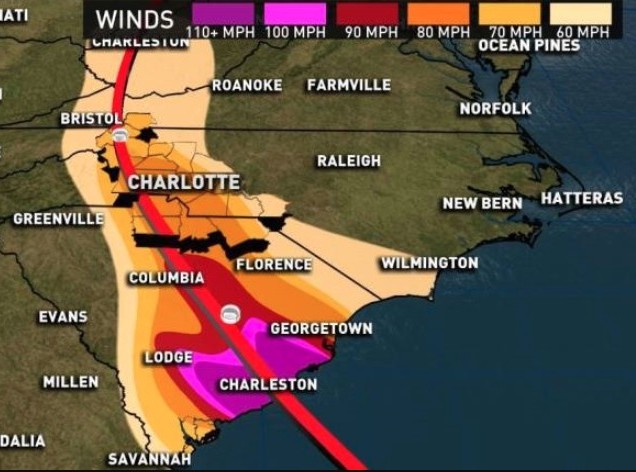
In the early morning hours of September 22, 1989 Hurricane Hugo passes over Cleveland County. There was widespread damage and thousands were without power for days.
April 1, 1990
The county’s population is 84,714, a 1.5% increase from 10 years earlier.
1994
A tornado causes $4 million in damage in Township 1, Boiling Springs, south Shelby, and the Oak Grove area.
1999
Wal-Mart moves from its location in the Marketplace Shopping Center in Shelby to a new location near the intersection of Dixon Blvd. and Earl Road. The new store is a Walmart “Superstore,” becoming the largest store in North Carolina for a time.
December 31, 1999
Cleveland County celebrations of the new millennium are held in various locations across the county; the county seat’s event drew several thousand people. (According to the U.S. Naval Observatory, the third millennium began on January 1, 2001. Even so, most Americans and much of the world focused on the flip of the calendar from ’99 to ’00; Prince wrote a song about it.)
January 1, 2000
12:00 AM passes and people everywhere are relieved the Y2K computer apocalypse did not happen.
February 14, 2000
Nine-year-old Asha Jaquilla Degree goes missing in from her home in upper Cleveland County in the early morning hours. She has not been seen since.
April 1, 2000
The county’s population is 96,287, a 13.7% increase from 10 years earlier.
September 11, 2001
Four highjacked planes crash into the twin towers of the World Trade Center, the Pentagon, and Shanksville, PA. Shelby natives, Amy Carroll and Michael Merritt, are in the vicinity of the twin towers; they both survive.
2002
A $50 million Walmart Distribution Center begins operations in Shelby.
December 4-5, 2002
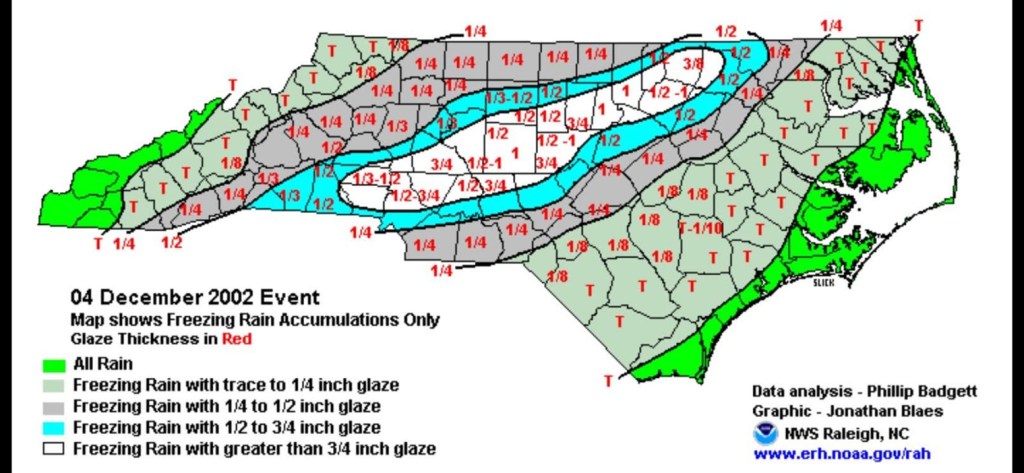
A major ice storm devastates the county causing widespread power outages due to broken tree limbs heavy with up to 1/2″ of ice.
Screenshot January 13, 2004
Cleveland County commissioners create the
Cleveland County Consolidated School System, merging the Kings Mountain, Shelby, and rural districts.April 1, 2010
The county’s population is 98,078, a 1.9% increase from 10 years earlier.
September 2013
The Catawba Indian Nation applies to the U.S. Department of the Interior to place land near Kings Mountain into federal trust for casino purposes. On July 1, 2021, the Catawba Two Kings Casino opens a temporary facility near Exit 5 of Interstate Hwy. 85.
June 18, 2015: The Capture of Dylann Roof
During a Bible study on June 17, 2015, at Emanuel African Methodist Episcopal Church in Charleston, South Carolina, Dylann Roof killed nine people and injured a tenth person–all African Americans. After several people identified Roof as the main suspect, he became the center of a manhunt that ended the morning after the shooting with his arrest in Shelby, North Carolina. Read more. . .
September 12, 2016
Shelby K9 Officer Timothy James Brackeen dies from gunshot wounds while trying to serve a warrant.
March, 2020
Cleveland County registers its first case of coronavirus. The COVID-19 pandemic begins.
April 1, 2020
The county’s population is 99,519, a 1.5% increase from 10 years earlier.
February 10, 2021
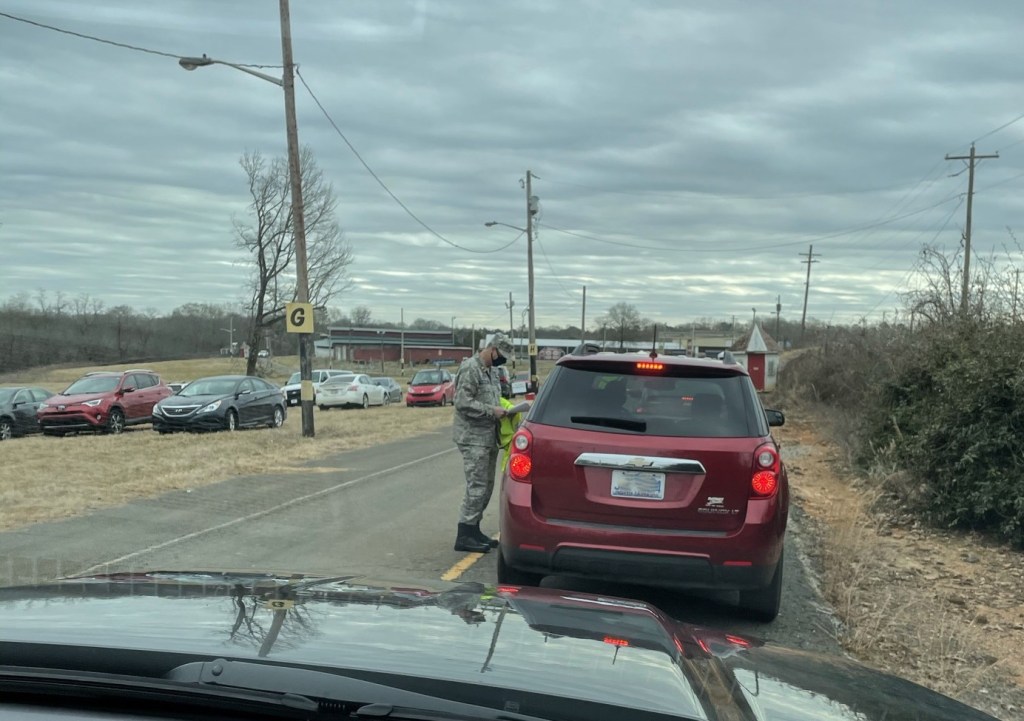
National Guard assists as Cleveland County residents line up to receive the first vaccinations against the coronavirus.
September 17, 2021
Kings Mountain Police Officer Carl Proper dies from complications as the result of contracting COVID-19 in the line of duty.
March 31, 2023
The Star published its final print edition. The newspaper transitioned to a digital-only format after that date, ending its print run after 128 years.
September 27, 2024
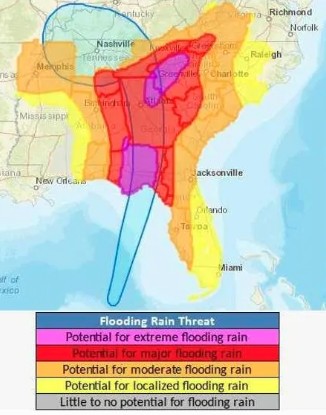
Hurricane Helene tracks into western North Carolina leaving devastation in the mountain areas around Asheville, Chimney Rock, and Lake Lure. People from the mountain areas come to Shelby for shelter and supplies, even though much of the county is without power.
 Cleveland County History