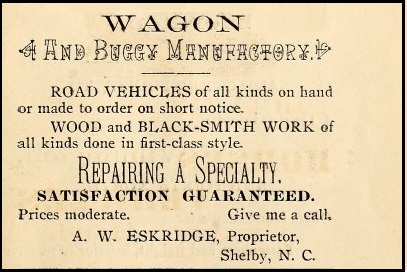
In the early years of Cleveland County, there were no large industries. There were flour and corn grist mills, tanneries, saddle and harness shops, iron works, wagon and buggy factories and such. There was at least one atypical manufacturing plant–a paper mill located on Buffalo Creek between Shelby and Waco. David Froneberger started this mill using old rags to make the paper.
Jedeth Roan Davis, a King’s Mountain attorney and local historian, wrote about Cleveland County history in a 1914 paper. He wrote that before before the civil war, the women made nearly all of the cloth for clothing the family. The men made shoes and hats. In the Sharon settlement Davis continued, there was a pioneer hat factory. From Our Heritage:
” In the Sharon’s settlement Davis continued, there was a pioneer hat factory. The hatters took hides of muskrats, otters and minks, fastened them to a flat table 10 feet above, which was suspended a large bow and string. The string was caught in the middle, pulled back arm’s length, and let fly, thereby cutting the fur from the hide. The hide was then boiled and cut into circles large enough for hats. The circular piece of hide put into the shape of a hat, and then a string was tied around it. These hats would last for several years. They usually sold for three dollars.“
Tobacco was grown in Cleveland County in the 1860s. There were four or five tobacco factories in Cleveland County between 1868 and 1885. Pipe tobacco, plug tobacco, and cigars were made in these factories.
An 1886 map of Cleveland County shows a vineyard in the vicinity of S. DeKalb Street in Shelby. This was a 15 acre vineyard with a winery where wine was made and aged in a two-story building there.
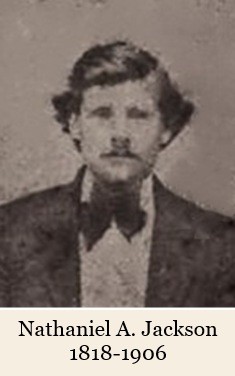
Manufacturing was boosted in 1871 when Nathaniel Abernathy Jackson built the first cotton textile mill in Double Shoals. It was located on the First Broad River. Later the mill was acquired by Elias Morgan and son Fred. They enlarged it and made other improvements.

Six miles north of this mill, a second textile mill was built in 1873. Major Henry F. Schenck built his mill along Knob Creek close to where it emptied into the First Broad River.
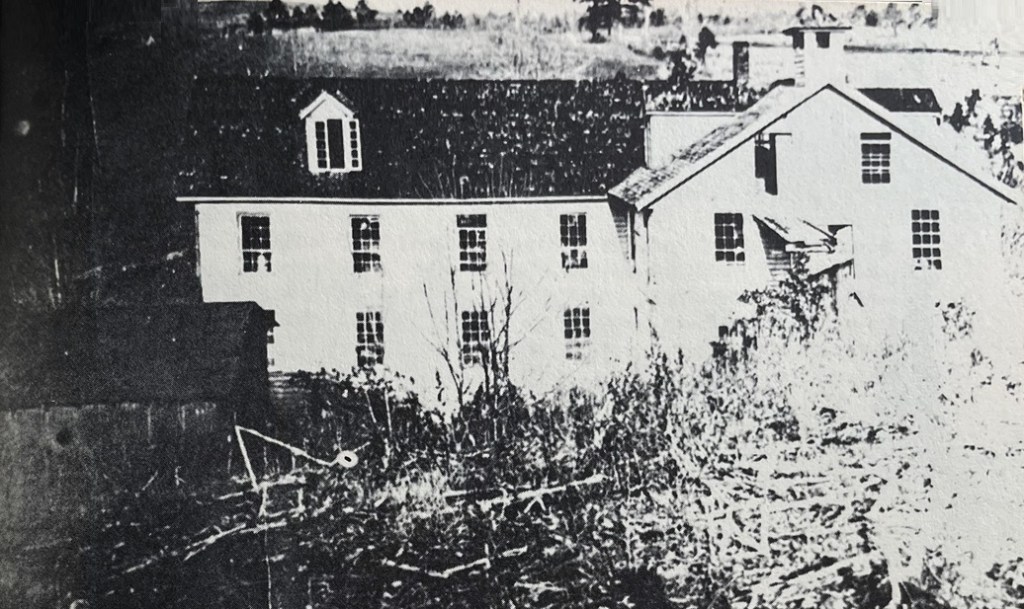

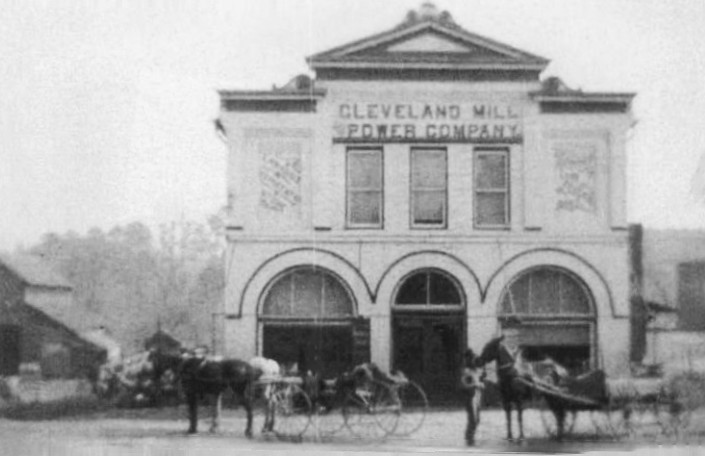
After forming a partnership with James E. Reynolds, a northern yarn commission merchant, a new mill was built in 1888. This one was located on the First Broad River in Lawndale. It was renamed Cleveland Mill and Power Company.
Cotton textile mills sprang up all over the county. The first cotton mill in Kings Mountain opened in 1888. Named the Kings Mountain Manufacturing Company, it was owned by Capt. Freno Dilling and members of the Mauney family. Its opening marked the beginning of the mill era in Kings Mountain.
Between 1892 and 1920, eleven mills were built in the Kings Mountain area, each with its own mill village, often including a store, clubhouse, and boarding house.
The Bonnie Mill, built by the Mauney family in 1900, was a yarn manufacturing facility, named after W.A. Mauney’s daughter.
Dilling Cotton Mill was founded in 1892-1894 by Captain Freno Dilling, later becoming the Phenix Mill after Burlington Industries acquired the property in the 1940s.
The Pauline Mill, founded in 1910 by Charles E. Neisler, Sr., and named for his wife, Ida Pauline Mauney Neisler, became a major producer of damask table linens and operated 130 Jacquard looms at one point.
The Pauline Mill was eventually combined with Neisler’s Margrace Mill and Patricia Mills under one corporate entity known as Neisco Mills, which ceased operation in 1955.
During the height of cotton production, Grover boasted 25 textile plants. One notable mill was the hosiery mill built by the Wilcox family, which later became Tryon Processing after Wilcox’s death in 1941.
After Wilcox’s death, R.A. Spooner took over the business, naming it Tryon Processing and moving it into the hosiery mill built by the Wilcox family.
The Dover Mills
The following is an excerpt from Textile Leaders of the South, written and published by James R. Young in 1963:
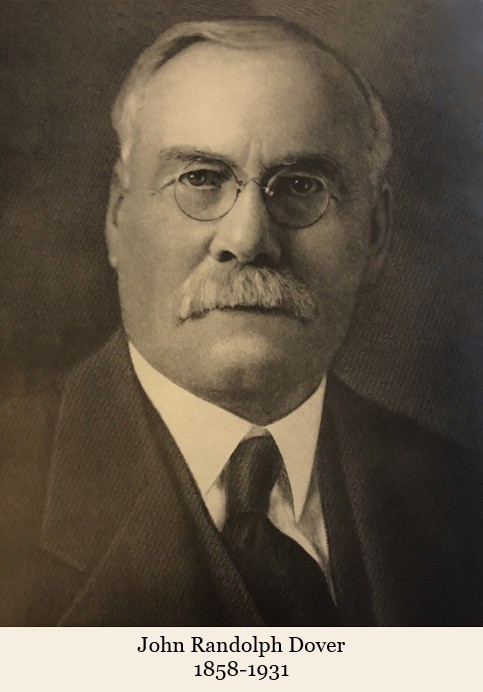
“John Randolph Dover of Shelby, North Carolina was a man with a great dream and the courage and perseverance to make that dream a reality. He envisioned an enterprise that would be famous for its manufacturing superiority, its employees, and he created this at Shelby in the process. He greatly advanced the textile field, helped Shelby to grow more prosperous, and contributed to the welfare and happiness of many persons.
Mr. Dover was descended from a centuries old English family in Dover, England. His parents, James M. and Amanda Nichols Dover, farmed in Cleveland County for many years. His father helped mine coal and iron for Confederate powder and shells during the War between the States. Mr. Dover was born December 14, 1858 in York County, South Carolina. He attended public schools in Shelby. He also attended the boys military school at King’s Mountain, but was largely self educated in the school of experience.
During his early business years, Mr. Dover was a cotton buyer, while buying the staple for meals, he determined to enter the manufacturing field in 1907. He settled in Shelby and built the Ella Mill named for his wife. To this he added the Catherine Weave Mill, which was later dismantled. He sold the Ella Mill to Consolidated Textile Corporation in 1921 and assumed the responsibility for finishing construction of the Eastside Mill of Shelby in 1923. He and associates built the better known Dover Mill, and in 1925 they added the Ora Mill. At his death in 1931, Mr. Dover was president and treasurer, and also a director of the Charles Mills at Red Springs.
At its inception, the Dover Mill employed 200 persons in producing a shirting fabric that was basically cotton with a rayon stripe. It pioneered in the development of rayon, and the Dupont Company did much of its in-process experimentation there. Under the guidance of Mr. Dover and his son J. R. Dover, Jr., who succeeded him in 1931, the plant expanded its production and its fabrics are for suiting, draperies, dresses, army Oxford, shoe tops, sports shirts, raincoats, wind breakers, corsets, nylon underwear, neckties, sport coats, top coats, tricot blouses, and night gowns.
Important as the development of products was, it was only part of Mr. Dover’s dream, along with the plants he developed model communities, including churches, schools, recreational, and other facilities. Mr. Dover’s employees had affection as well as respect for him because of the many services he provided, and especially for his counsel and advice. They went to him with their problems, received his advice, and acted on his counsel much as children might with their father.
Mr. Dover was a gifted speaker, and though he did not enter politics, he frequently spoke in support of men he considered worthy of office. He also spoke in church, was a close student of the Bible, and sought to practice the tenets of Christianity in his daily life. He assisted in the establishment of several Baptist churches and supported various Baptist institutions, educational, charitable, and others. At various times he was a director of the Union Trust Company of Shelby, president of the Rotary Club, and active in Masonry.
In September 1887, Mr. Dover was married to Miss Ella Esther Toms, daughter of J. M. and Priscilla Wray Toms of Rutherford County. They had nine children, including John Randolph Dover, Jr., who succeeded his father as president of the mills, and Charles Irvin Dover, secretary treasurer. Mrs. Dover actively participated in her husband’s philanthropic undertakings during his lifetime and continued many of them after his death.
Mr. Dover’s success as a textile pioneer, and a humanitarian was attested by leading North Carolina newspapers at the time of his death. The Charlotte Observer said in part… ‘in the death of Mr. John R. Dover, the textile industry of Piedmont, North Carolina loses one of its pioneer leaders. one who rose from the humble position of farm lad to command of great textile interest as one of the state’s most successful of cotton mill executives.‘ “
| mill/location | founders | dates of operation |
| Double Shoals Mill | Nathaniel A. Jackson | 1871-1980s |
| Double Shoals Mill, sold to. . . . . . . . . . . | Elias Morgan and son, Fred Morgan | |
| Cleveland Mill/ Knob Creek north of Lawndale | Henry F. Schenck | 1873 |
| Belmont Cotton Mill Shelby | E. A. Morgan, T. F. Cline, H. Cline, and E. A. Wright (Morgan, Cline, and Company) | 1887-1895 |
| Belmont Cotton Mill | A. C. and R. B. Miller | 1895- |
| Cleveland Mill and Power Company/ First Broad River, Lawndale | Henry F. Schenck and James E. Reynolds | 1888 |
| Kings Mountain Manufacturing | Freno Dilling, Jacob Mauney, W. Andrew Mauney | 1888 |
| Shelby Cotton Mills | Morgan, Cline & Co. | 1889-1960s |
| Laurel Mills/ Broad River near Shelby | R. B. Miller | 1889 |
| Enterprise Mill Kings Mountain | Erskine Falls | 1892 |
| Dilling Mill (Phenix Mill) Kings Mountain | Freno Dilling | 1893-1982 |
| Buffalo Manufacturing Stubbs | T. D. Lattimore | 1896- |
| Irene Mill Boiling Springs | Durham Shoals Manufacturing Co. (J. A. Carroll and H. D. Wheat) | 1896- |
| Laura Glenn Mill | John E. Hurst and R. B. Miller | 1896- |
| Cora Mill/ Kings Mtn. | 1900 | |
| Bonnie Mill Kings Mountain | W. Andrew Mauney | 1900 |
| Pauline Mill Kings Mountain | Charles E. Neisler | 1910 |
| Margrace Mill Kings Mountain | Charles E. Neisler | 1914 |
| Patricia Mill Kings Mountain | Charles E. Neisler | 1920 |
| Lily Mill/ Shelby | John F. Schenck, W. E. Morton, and Harris Ramseur | 1905 |
| Ella Mill/ Shelby | John R. Dover | 1907 |
| Minette Mill/ Grover | 1919 | |
| Dover Mill (Doran Mill)/ Shelby | John R. Dover | 1921-2001 |
| Ora Mill | John R. Dover | 1925 |
| Cleveland Cloth Mill Shelby | O. Max Gardner, Odus M. Mull, and Charles C. Blanton | 1925 |
PPG (Pittsburg Plate Glass) broke ground on a fiberglass plant in the Washburn Switch area of Cleveland County in 1958. A year later, it celebrated its opening by inviting the public in to tour it. A chartered train brought numerous people from the depot in Shelby to the plant. Many Baby Boomers remember the train ride and tour.
PPG became Cleveland County’s largest employer and a key part of the local economy.

Pittsburg Plate Glass, Washburn Switch Community, Cleveland County, NC. 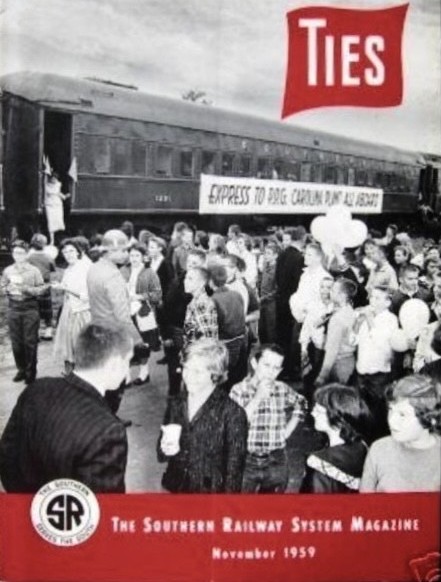
Photo from the collection of Rusty Patterson. 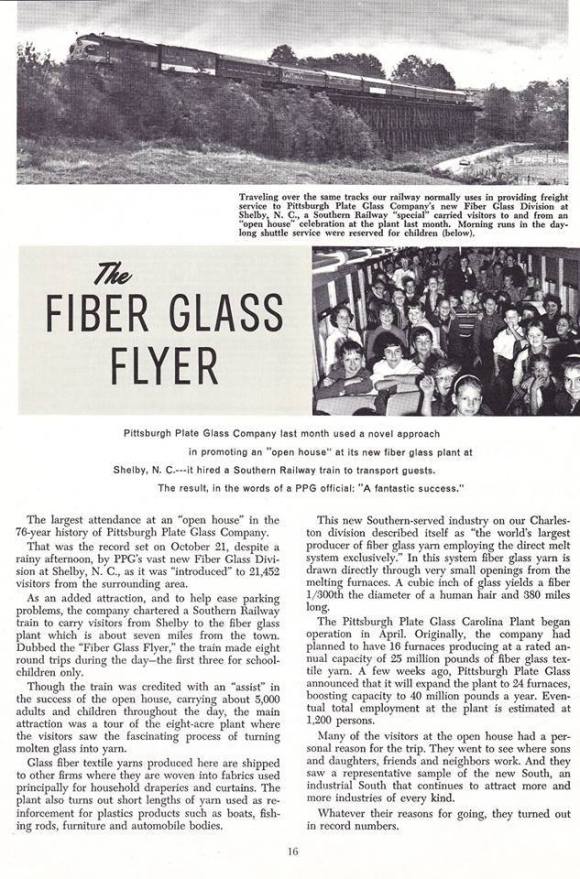
The train is traveling over the trestle that still stands near the First Broad River Trail on West Grover Street in Shelby. 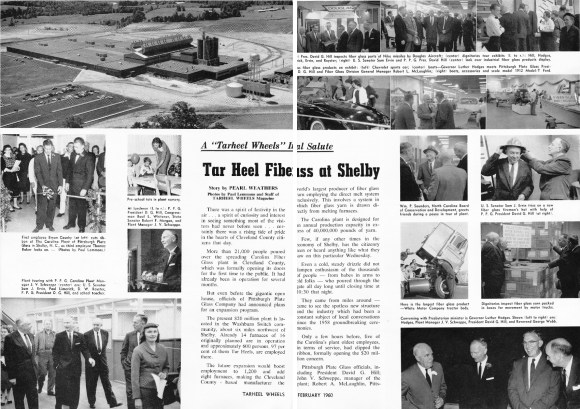
Photo from the collection of Wanda Causby Rabb. 
From the collection of Brenda Costner.
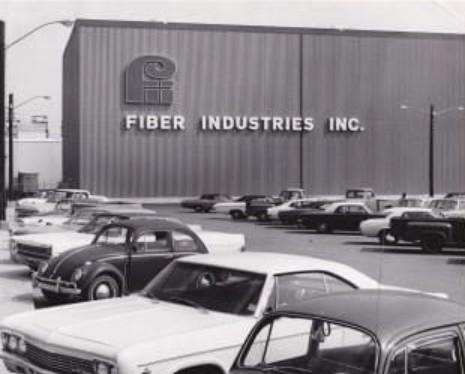
In 1960, Cleveland County had the good fortune of having another major industry build in the county. Fiber Industries built a massive plant in the area between Patterson Springs and Earl.
In the 1980s, things began to change for the textile industry–as a whole, not just in Cleveland County. While import competition has been blamed for much of the job losses in the industry, domestic factors, including local competition, industry consolidation and productivity gains from improved machinery and manufacturing processes, have had a similar impact on textile and apparel employment. At any rate, in Cleveland County, cotton is no longer king–nor is it a textile center as it once was.
| Additional information on Cleveland County textile mills. |
| Historical background on the Double Shoals Cotton Mill |
| Historical background on the Shelby Cotton Mill |
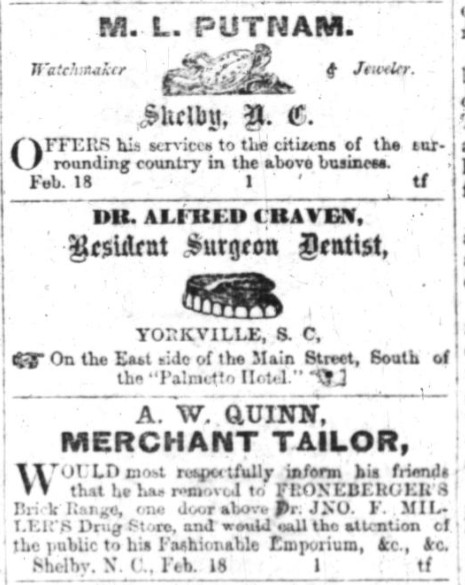
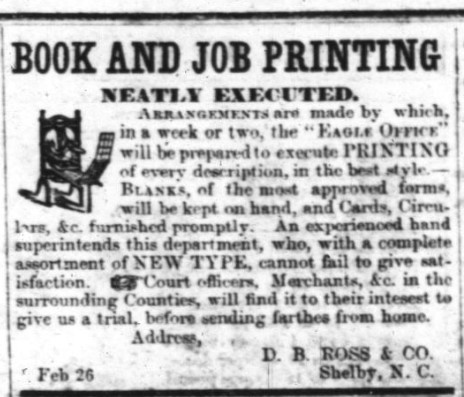
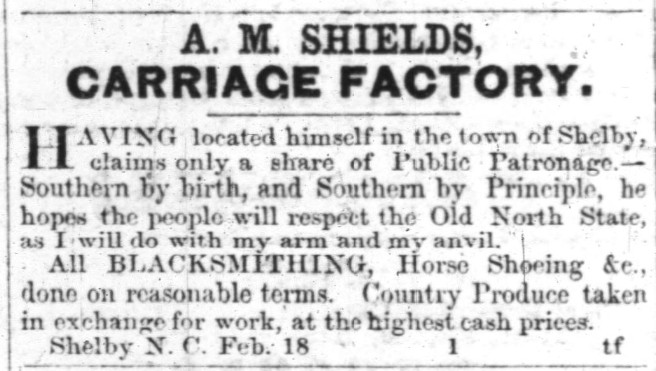
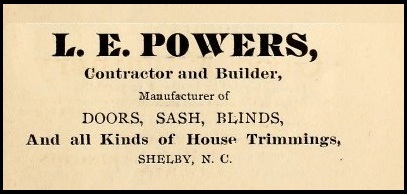
Trades
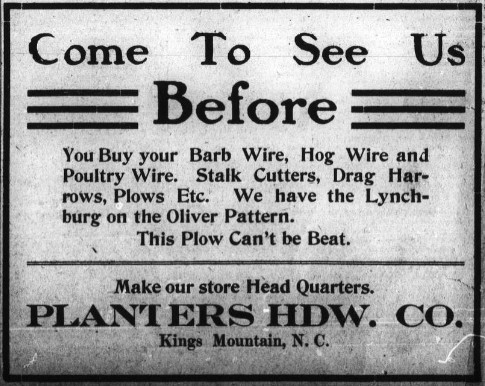
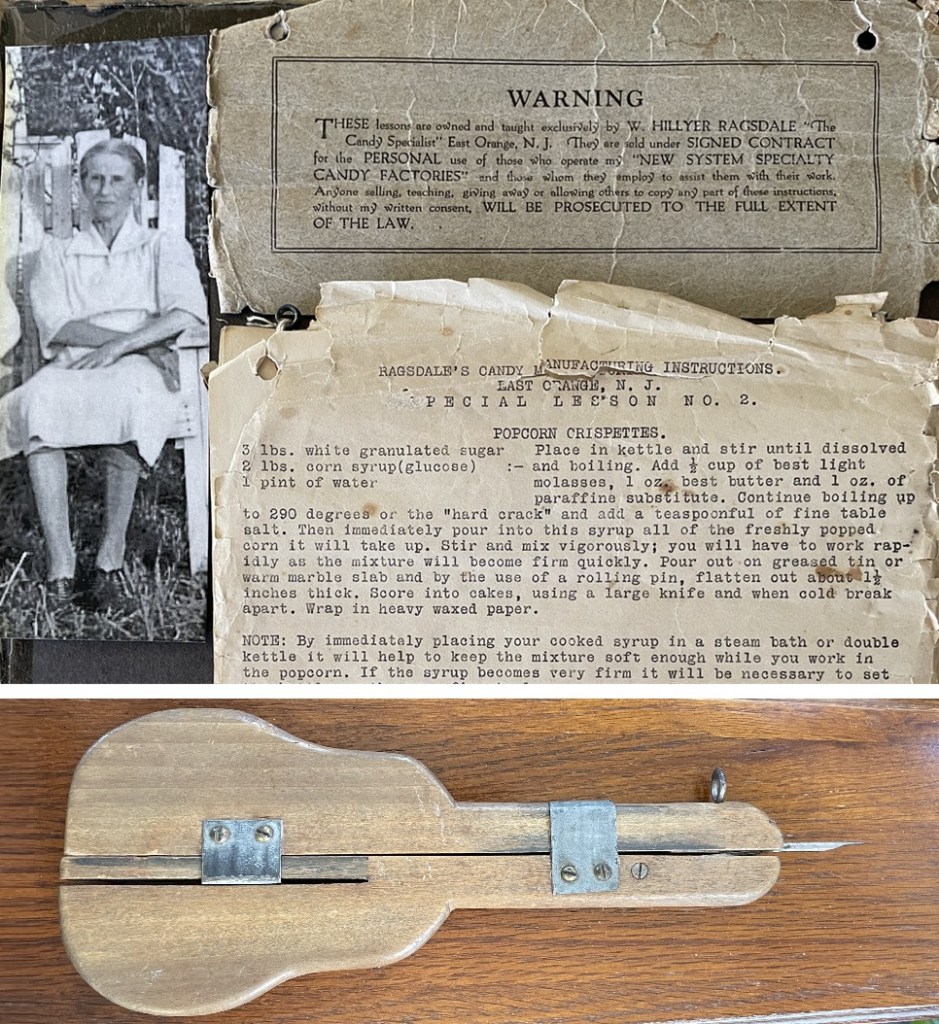
A variety of trades and services have evolved over time to serve the people of Cleveland County–from horse and buggy days to computer and cell phone repair today.
From an 1861 Mountain Eagle:

From an 1875 Shelby Aurora:


 Cleveland County History