Over the past two centuries, Cleveland County has witnessed a remarkable evolution in its educational landscape, shaped by the establishment of schools, colleges, and libraries. From humble beginnings in the early 19th century, with one-room schoolhouses serving local communities, the area’s commitment to education has steadily grown. The integration of institutions such as Gardner-Webb University and Cleveland Community College has provided higher education opportunities and fostered academic growth. Libraries, as vital resources for knowledge and community engagement, have also emerged, enhancing literacy and accessibility to information for residents of all ages. This rich educational history reflects Cleveland County’s ongoing dedication to learning and development throughout the generations.
Timeline of Key Events in the History of Education in North Carolina
1817
Senator Archibald D. Murphey of Orange County, NC proposes a statewide system of public schools.
1825
The State Literary Fund is created to support such a system, but the fund was inadequate until supplemented in 1836.
1836
The bulk of a federal surplus of $1.5 million goes toward the Literary Fund and public education.
1839
The Education Act is passed by the General Assembly; it is revised in 1841, creating North Carolina’s earliest public school system. The state’s first “common” school opened in Rockingham County in January 1840.
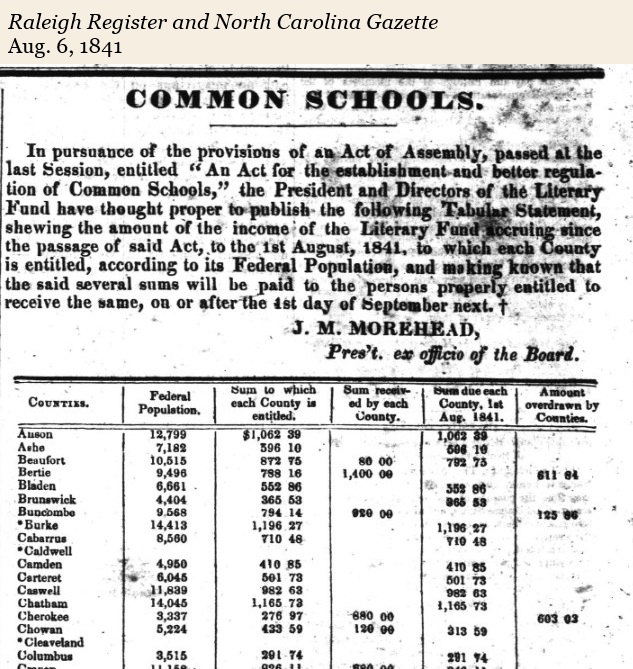
Aug. 1, 1841
The North Carolina General Assembly appropriates a portion of its state funding to the newly formed Cleaveland County.
January 27, 1849
The NC General Assembly passes an act to authorize the establishment of a male and female academy in or near the town of Shelby. See transcribed details.
1852
The NC General Assembly creates the post of state superintendent of common schools to head the Department of Public Instruction. Calvin H. Wiley, a Guilford County, serves as the first superintendent from 1853 to 1865.
1862
The State Educational Association endorses Superintendent Wiley’s proposal for a comprehensive system of primary, grammar, and secondary instruction in every county. It took more than two years for Wiley’s proposal to pass both houses of the legislature.
1868
The rewritten NC Constitution establishes a system of free public schools for all children in the state, requiring the General Assembly to provide and maintain this system through taxation. This marked a significant step towards universal access to education, ensuring that all children, regardless of race or background, could receive a basic education. The Greensboro Graded School, approved by voters in May 1870, becomes the first public graded system in North Carolina. Others follow suit.
March 6, 1877
The NC General Assembly passes an act to incorporate the Kings Mountain Baptist (Association) Female Seminary in the town of Shelby.
February 28, 1899
The NC General Assembly passes an act to amend the February 22, 1883 act incorporating King’s Mountain High School. This act specifies that all trustees would now be elected by the qualified voters of the town of Kings Mountain.
1901
The NC General Assembly appropriates tax funds for public schools for the first time in the state’s history.
1905
The NC General Assembly passes legislation requiring every county school board to begin mandatory attendance for a 16-week annual term for all children between ages 8 and 16.
1906
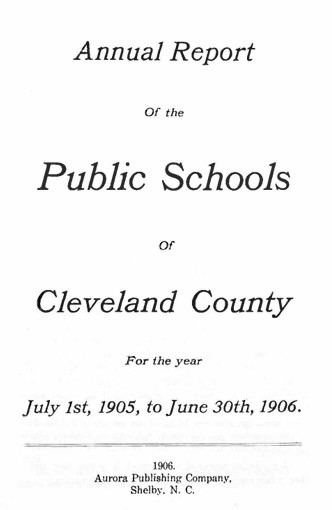
Bayard T. Falls, Superintendent of Cleveland County Public Schools, releases his annual report to the county school board. Access it here.
1907
The Rural High School Act and consolidation of rural school districts, as well as a program of “equalization” in the distribution of funds for education, leads to the gradual improvement of free public education. By 1911, 200 public rural high schools were distributed among the state’s 100 counties.
1913
The NC General Assembly of enacts the Compulsory Attendance Act requiring that all children, both black and white, between the ages of 8 and 12 attend school continuously for four months a year, allowing reasonable exemptions.
1920s
School consolidation efforts increase. Consolidation resulted in available resources being combined and afforded less-populated areas the advantages of better-funded urban schools.
June 22, 1944
President Franklin D. Roosevelt signs the Servicemen’s Readjustment Act of 1944. It would become known as the “GI Bill” from which millions of veterans would receive an education.
1964
The Civil Rights Act passes. It bans discriminatory practices in employment and ends segregation in public places such as swimming pools, libraries, and public schools.
1972
Title IX is enacted as part of the Education Amendments of 1972. It prohibits sex-based discrimination in any school or any other education program that receives funding from the federal government.
1974
The Family Educational Rights and Privacy Act (FERPA, also known as the Buckley Amendment) is enacted. It protects the privacy of student education records and grants parents and eligible students the right to inspect and review those records. It also limits the disclosure of student information without parental or student consent. For example, teachers could no longer post grades where other students could see them.
1982
The U.S. Supreme Court case Plyler v. Doe rules that states cannot deny undocumented children access to free public education, as doing so violates the Equal Protection Clause of the Fourteenth Amendment. This landmark decision ensures that all children, regardless of their immigration status, have the right to a public education.
1983
Graduation requirements increased from 18 to 20 units, effective with the the class of 1987.
North Carolina Scholars program started.
1984North Carolina Commission on Education for Economic Growth issued report and recommendations that influenced reform efforts.
1985Basic Education Program enacted by General Assembly for implementation 1985-93.
North Carolina Career Development Program started.
End-of-Course Testing Program began.1988
Homeschooling is legalized in North Carolina.
1989
Bob Etheridge is elected State Superintendent. He restructures the Department of Public Instruction
and uses federal Chapter 1 money for early childhood education for disadvantaged children and to obtain state funding for early childhood programs, to lower the dropout rate and to boost scores on the Scholastic
Aptitude Test.
By 1993, the efforts paid off with the lowest dropout rate in state history–less than 3 percent per year–and with increases in state average SAT scores. In fact, in four years (1989-1993) North Carolina’s SAT scores improved by 23 points.1993
The State’s new end-of-grade testing program begins in grades three through eight
| Additional Information on Education in NC |
| The History of Education in NC |
 Cleveland County History