The 1830s was a period of expansion and development in North Carolina. With the arrival of new settlers and the establishment of agriculture as the backbone of the economy, the area quickly began to thrive. This area’s landscape, characterized by rolling hills and lush valleys, provided ideal conditions for farming, which attracted more residents.
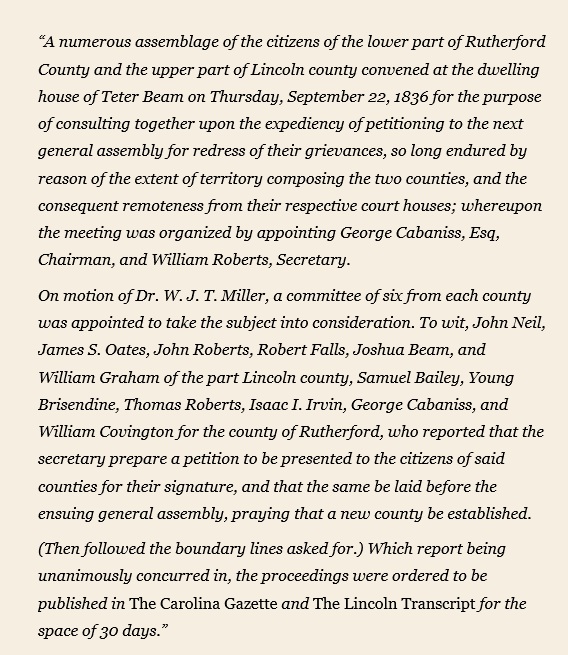
Many in the midst of this area began to recognize the need for more localized governance and representation for residents in this growing region. On September 22, 1836, several people met at the home of Teter Beam.1 During that first meeting George Cabaniss was elected Chairman and William Roberts, Secretary. On motion of Dr. W. J. T. Miller, a committee of six from each county was appointed to take the subject into consideration:
| From Lincoln County: | |
| • Joshua Beam | • John Neil |
| • Robert Falls | • James S. Oates |
| • William Graham | • John Roberts |
| From Rutherford County: | |
| • Samuel Bailey | • William Covington |
| • Young Brisendine | • Isaac J. Irvin |
| • George Cabaniss | • Thomas Roberts |
With this meeting the campaign for a new county was launched. Below is the transcript of the proceedings sent to be published in The Carolina Gazette and The Lincoln Transcript.
It took five years and two legislative rejections before the new county was finally approved by the North Carolina legislature. The bill to create a new county from an eastern portion of Rutherford County and a western portion of Lincoln County was introduced by Dr. W. J. T. Miller of Rutherford County on January 11, 1841. This time the bill passed.
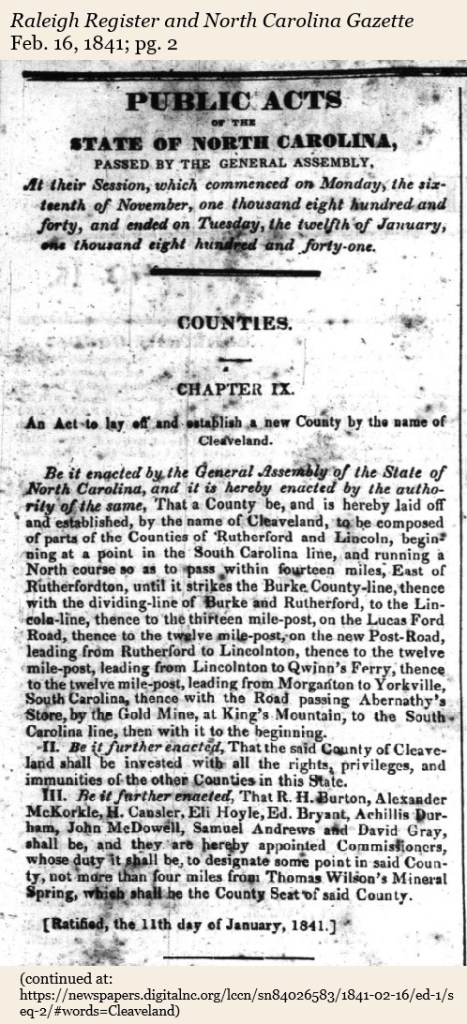
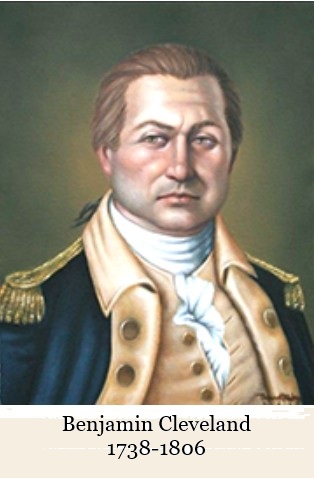
The new county was named for Colonel Benjamin Cleveland, a formidable Patriot commander during the Battle of Kings Mountain. For some unknown reason the spelling of the county was filed as “Cleaveland.” It wasn’t until 1887 that the spelling was changed by legislative action to “Cleveland” County. Grover Cleveland was president at the time, so it made the spelling consistent.
From the Revolutionary War period until 1868, counties were governed by justices of the peace. These men were not elected; they were appointed by the governor, based on recommendations by the General Assembly. Those appointed served on the county’s Court of Pleas and Quarter Sessions.
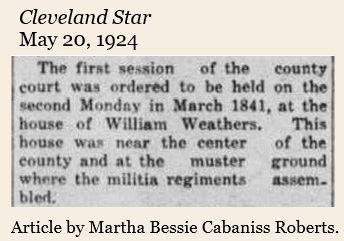
The first county court session was held March 8, 1841 on the second floor of the home of William Weathers in the Zion Church community.
Participants were the following:
Esquires:
- Burrel B. Bridges
- Simon McCurry
- Green B. Palmer
Justices of the Peace:
- Joshua Beam
- Charles Blanton
- Burrel B. Bridges
- James W. Cabaniss*
- Christopher Carpenter
- Davis Collins
- John Dickson
- Colman Doggett*
- William Eskridge
- John L. Gladden
- William M. Gold
- William H. Green
- Pascal T. Grigg*
- Thomas M. Hardin
- Richard Harrill
- Richard T. Hord
- Edmund Jones
- Simon McCurry
- James McNealy
- William W. Morris
- Green B. Palmer
- Edward Rippy
- Thomas Roberts*
- James Roberts
- Christopher Stroup
- William A. Tisdale
- John Tucker
- William Weathers
- Giles Williams
*These four men were appointed Justice of the Peace and took the oath of office that day.
Elections were held in those first days of court:
- Charles Blanton, Sheriff
- Joshua Beam, County Trustee
- Young Brisendine, Trustee of Public Buildings
- John L. Gladden, Ranger
- William H. Green, Register
- William Harrill, Entry Taker
- T. W. Herndon, Solicitor
- John R. Logan, County Surveyor
- John K. Wells, Coroner
- A. R. Homesly, Clerk of the Court of Pleas and Quarter Sessions
Special Court members were elected:
- Burrel B. Bridges
- Richard T. Hord
- William W. Morris, Chairman
- Edward Rippy
- John Tucker
Court Appointments:
- Col. W. M. Carson and Edmund Jones were appointed commissioners to run the boundary line between Rutherford and Cleaveland and to act with the Commissioners on the part of Rutherford. Samuel S. Gidney was appointed Surveyor.
- Christopher Carpenter and Christopher Stroup were appointed commissioners to run the boundary line between Lincoln and Cleaveland; Thomas Roberts was appointed Surveyor.
- William Eskridge, Richard T. Hord, and William Weathers were appointed to serve on a committee to select names from a tax list to fill the jury box.
- Joseph Carroll and William Wray were appointed Deputy Sheriffs.
- Jacob Conner was appointed Processioner.
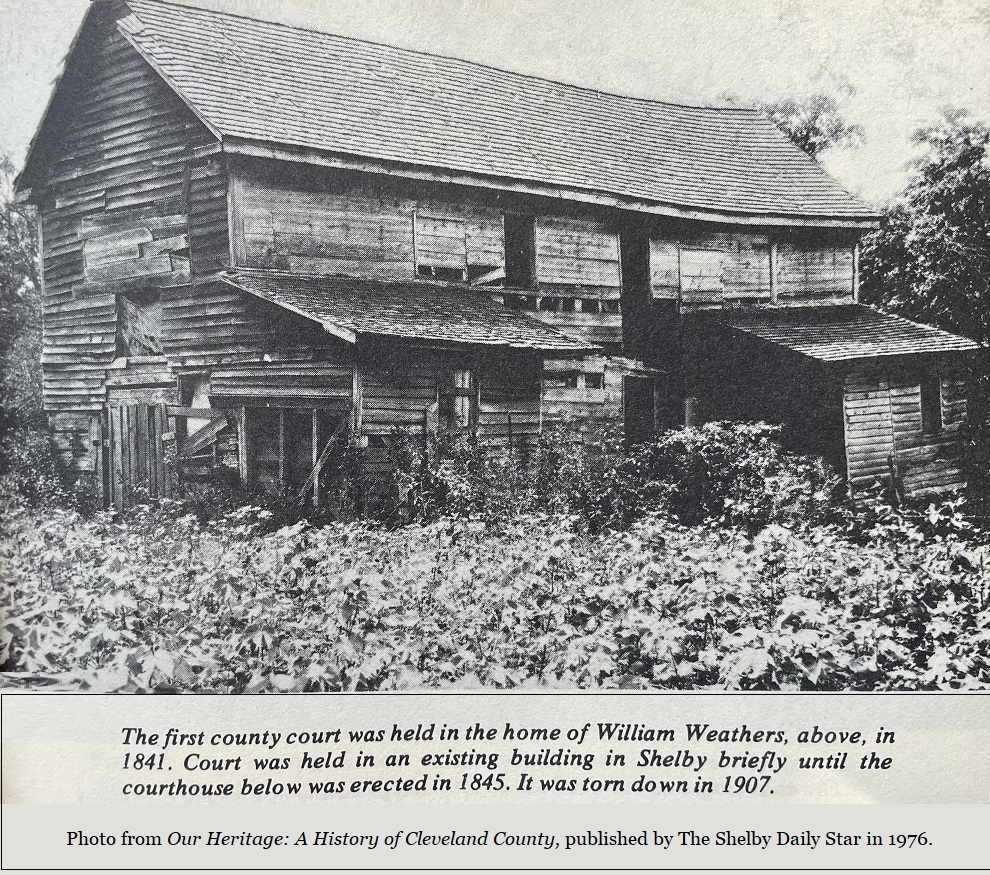
North Carolina’s county government system evolved significantly with the 1868 Constitution, shifting from appointed officials to elected boards of commissioners and other local officers, giving citizens more control. This structure was later modified in 1875, allowing the legislature to change election methods (like having justices elect commissioners). It was refined further with the official creation of the State Association of County Commissioners in 1908-1909, promoting collaboration and advocacy for modern county governance.
Cleveland County’s first members to form the Board of Commissioners after the 1868 change were appointed by NC Governor William Holden. They were Albert V. Blanton, Lewis Gardner, William B. McCall, and J. Tilford Price. This new Board of Commissioners elected the following county officials:
| Isaac O. Bridges | Register of Deeds |
| Joseph C. Byers | Sheriff |
| Eli H. Fulenwider | Treasurer |
| Elisha McBrayer | Clerk of the Court |
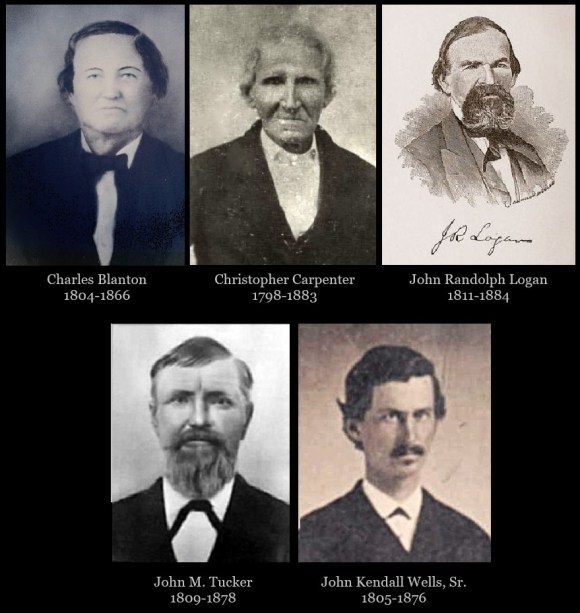
Founders of Cleaveland County. This is a “virtual cemetery” of the memorial pages of some of the men who were involved in the organization of the new county in 1841. There were surely more, but these are the men cited in the book, Our Heritage: A History of Cleveland County, published by The Shelby Daily Star in 1976.
Photographs or sketches survive for five of them.
The creation of the county in 1841 marks a significant milestone in the region’s development, reflecting the larger narrative of American expansion and the pursuit of community representation.
- John Teeter Beam (1732-1807) was a prominent German immigrant who lived in the western portion of Lincoln County. His son was Teter Beam (1795-1884), but he also had a grandson named John Teeter Beam (1812-1874). It is assumed the meeting took place at the son’s residence. All three are buried at the New Prospect Baptist Church cemetery. ↩︎
 Cleveland County History