The Korean Conflict, 1950-1953
When North Korea invaded South Korea in June 1950, the United States sponsored a “police action”—a war in all but name—under the auspices of the United Nations. The Department of State coordinated U.S. strategic decisions with 16 other countries, contributing troops to the fighting.
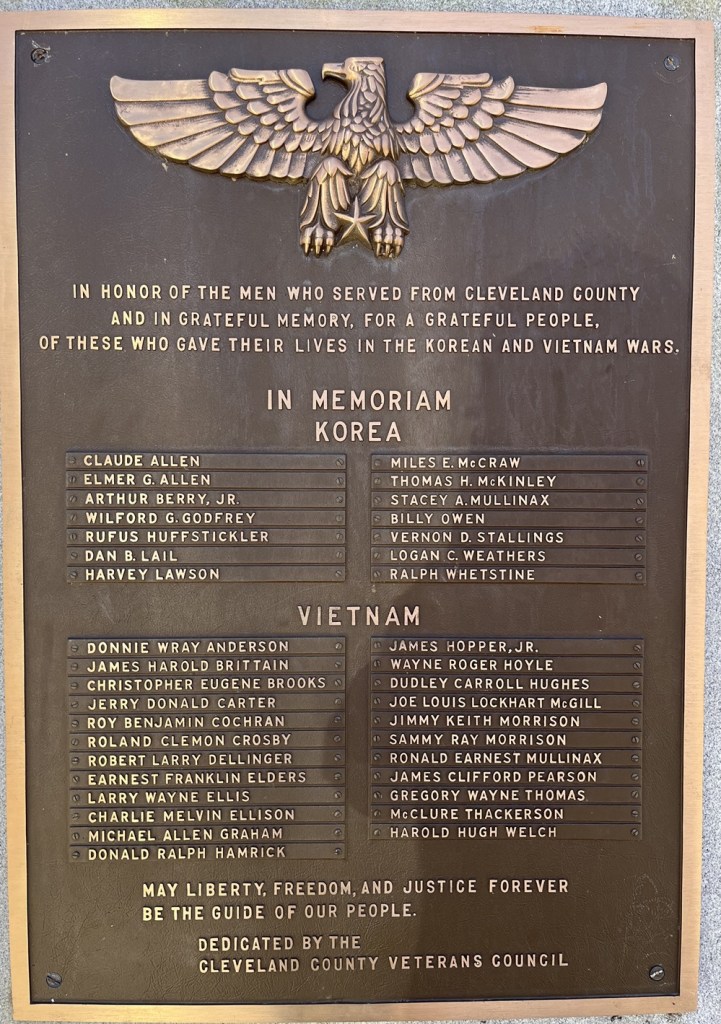
The Cleveland County Veterans Council erected this monument on the north side of the Cleveland County Court Square to honor the memory of the 14 Cleveland County men who died while serving during the Korean Conflict: Claude Allen, Elmer G. Allen, Arthur Berry, Jr., Wilford G. Godfrey, Rufus Huffstickler, Dan B. Lail, Harvey Lawson, Miles E. McCraw, Thomas H. McKinley, Stacey A. Mullinax, Billy Owen, Vernon D. Stallings, Logan C. Weathers, and Ralph Whetstine.
The Vietnam Conflict, 1954-1975
The United States entered Vietnam in 1955 with the principal purpose of preventing a communist takeover of the region. The war ended 30 April, 1975.
The monument (above) honors the memory of the 23 Cleveland County men who died while serving during the Vietnam Conflict: Donnie Ray Anderson, James Harold Brittain, Christopher Eugene Brooks, Jerry Donald Carter, Roy Benjamin Cochran, Robert Larry Dellinger, Earnest Franklin Elders, Larry Wayne Ellis, Charlie Melvin Ellison, Michael Allen Graham, Donald Ralph Hamrick, James Hopper, Jr., Wayne Roger Hoyle, Dudley Carroll Hughes, Joe Louis Lockhart McGill, Jimmy Keith Morrison, Sammy Ray Morrison, Ronald Ernest Mullinax, James Clifford Pearson, Gregory Wayne Thomas, McClure Thackerson, Harold Hugh Welch.
Persian Gulf War/Kuwait, 1990-1991
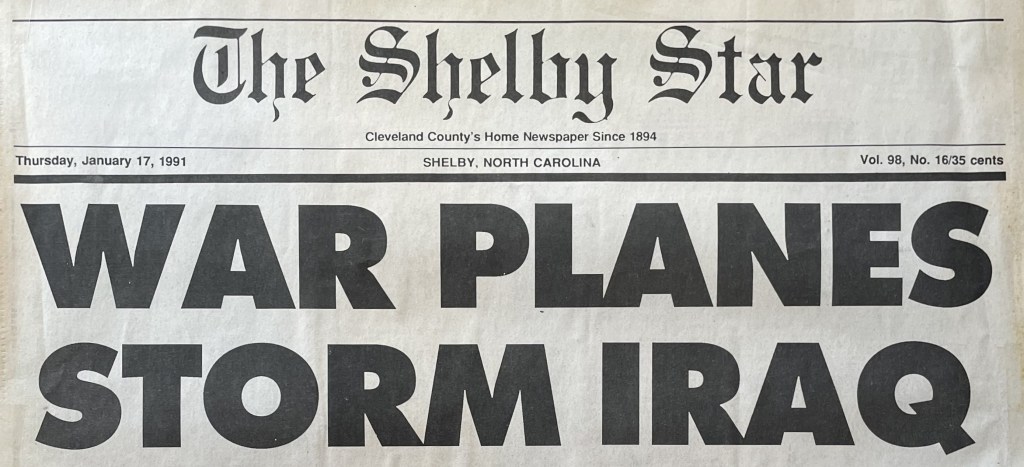
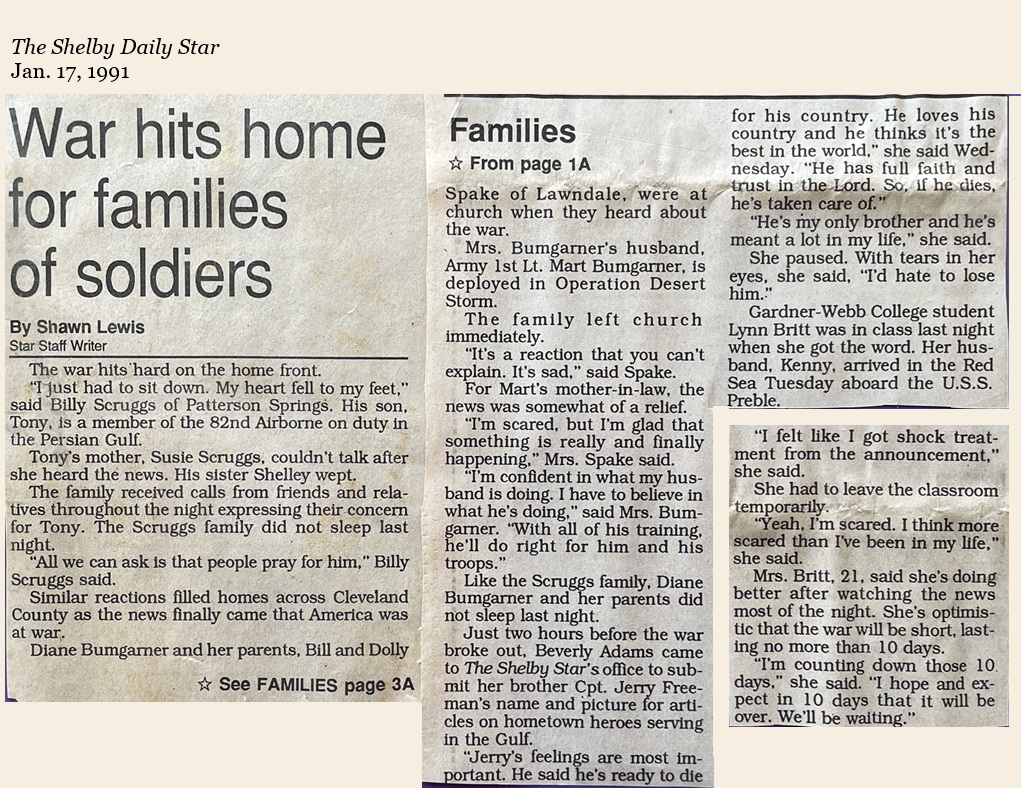
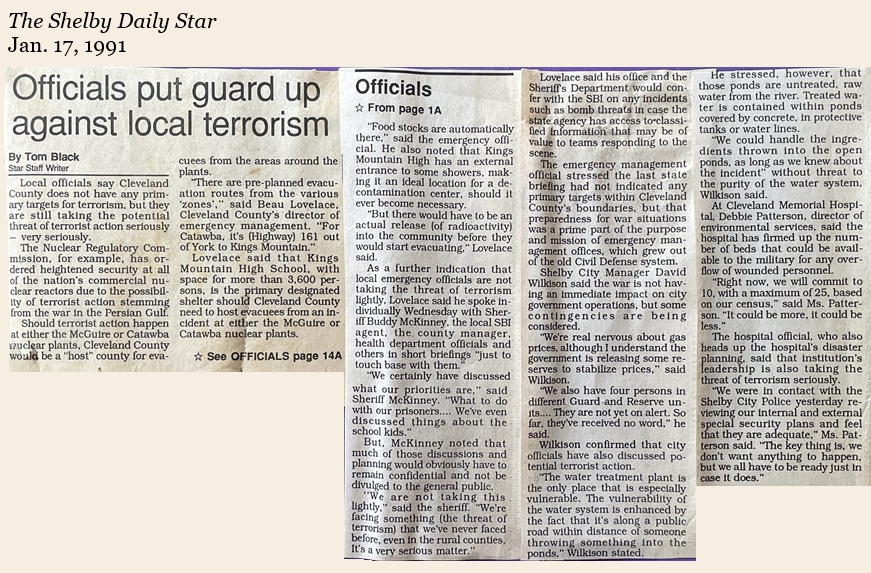
The U.S. went to war in Iraq in 1991 (the Persian Gulf War) because Iraq, led by Saddam Hussein, invaded and occupied neighboring Kuwait in August 1990, defying international demands to withdraw. This invasion threatened global oil supplies and regional stability, prompting a U.S.-led coalition of 35 nations to launch “Operation Desert Storm” (Jan-Feb 1991) to liberate Kuwait and restore its sovereignty.
Afghanistan War, 2001-2021
The U.S. went to war in Afghanistan in 2001 in response to the 9/11 terrorist attacks, to dismantle al-Qaeda and punish the Taliban regime for harboring them. The Taliban refused President Bush’s demand to hand over al-Qaeda leaders like Osama bin Laden, leading to “Operation Enduring Freedom” to eliminate the terrorist threat and remove the Taliban from power, preventing Afghanistan from being a terrorist safe haven.
Iraq War, 2003-2011
The U.S. invaded Iraq in 2003 primarily to topple Saddam Hussein’s regime, based on claims he possessed “Weapons of Mass Destruction” (WMDs) and had links to terrorism (specifically al-Qaeda), though these claims proved false after the invasion, which also aimed to bring democracy and stability to Iraq. The Bush administration framed the invasion as part of the broader War on Terror, post-9/11, asserting Iraq posed an imminent threat, despite UN inspectors finding no active WMD programs.
 Cleveland County History